

About > 

Man in a dark t-shirt and sunglasses stands smiling in front of the Trevi Fountain in Rome, with ornate statues behind him.

Ashton Bretzer

Senior Reservoir and Completions Engineer

Ashton Bretzer is a Senior Reservoir and Completions Engineer at ResFrac, where he helps energy companies optimize fracturing operations and reservoir development. He has over ten years of experience in fracturing and stimulation across both conventional and unconventional reservoirs.

Prior to joining ResFrac, Ashton worked at TAQA Well Services in Saudi Arabia, focusing on HPHT acid and proppant fracturing design, modeling, optimization, and execution. During his time in the Middle East, he led the first CO₂ foamed fracturing treatments for two different service companies in Saudi Arabia and supported multiple field trials and the implementation of new technologies.

Earlier in his career, Ashton worked at Baker Hughes and BJ Services in Canada, delivering technical and operational expertise to a wide range of clients across the country’s major oil and gas plays.

Ashton holds a Bachelor of Science in Chemical Engineering from the University of Saskatchewan and has published several technical papers for various SPE conferences. Outside of work, he enjoys traveling and exploring different parts of the world and spending time at his family cabin by the lake.

Ashton's posts

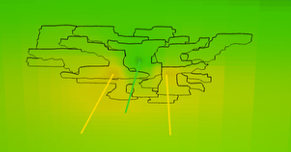
Abstract illustration with multiple outlined maps over a green-to-yellow gradient and light beams.

The influence of well configuration on water loss in Enhanced Geothermal Systems

Recently, ‘water loss’ has been a hot topic of discussion for EGS. Fervo reported that they have been producing only 70% of the fluid volumes that they have been injecting at their Project Red. The FORGE project reported a roughly 10% water loss rate. Because projects will have finite water rights, these results have led to concern that growth of EGS will be limited by excessive water consumption. This is a valid concern, and water availability is a legitimate factor in site-selection and project engineering. However, I believe that the problem has been overstated.
Read more
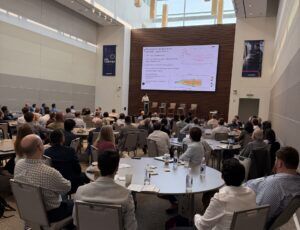
Large conference room with a speaker presenting a slide deck to an audience seated around circular tables.

2026 ResFrac Annual Symposium Recap

On June 25, 2026, we got the ResFrac community together both in-person at the ExxonMobil campus in Spring, Texas, and virtually around the globe for our Annual Symposium. With our community growing as fast as it is, the energy in the room was absolutely buzzing. We had a jam-packed day of operator case studies, deep-dive technical sessions, and some incredible geomechanical insights from industry legends.

Read more
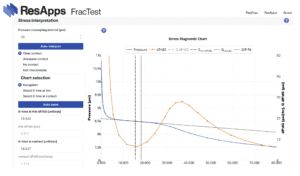
ResApps FracTest interface showing a Stress interpretation section with an Auto-interpret button and contact options, next to a Stress Diagnostic Chart.

FracTest – An Online Tool for DFIT Interpretation

This week, we are releasing FracTest, a web-based application for interpretation of diagnostic fracture injection tests (DFITs). FracTest is available at resapps.resfrac.com, alongside our other two ResApps, StageOpt and IntTest. DFITs are small-volume fracture injection tests used to estimate stress, pore pressure, and permeability. These quantities form the foundation of the fracture and reservoir engineering work that we do in ResFrac, and so we view DFIT interpretation as one of the most important parts of our workflow.

Read more

Meet the ResFrac team

Learn why both independents and supermajors trust ResFrac

Search