
Mark McClure, Kevin Eslick, Eric Schulz, and Charles Kang
ResFrac Corporation
This week, we are releasing FracTest, a web-based application for interpretation of diagnostic fracture injection tests (DFITs). FracTest is available at resapps.resfrac.com, alongside our other two ResApps, StageOpt (see summary or case study) and IntTest (see summary, or case study).
DFITs are small-volume fracture injection tests used to estimate stress, pore pressure, and permeability. These quantities form the foundation of the fracture and reservoir engineering work that we do in ResFrac, and so we view DFIT interpretation as one of the most important parts of our workflow.
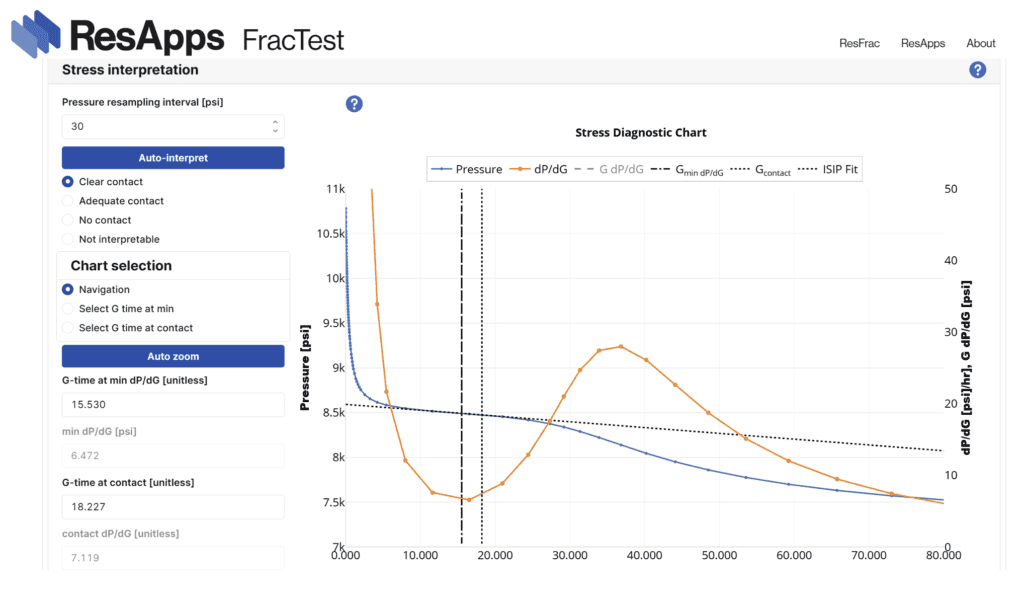
FracTest
FracTest implements the DFIT interpretation workflow developed in URTeC-2019-123. It expanded on the findings published in SPE-179725. A later ‘practical guide’ was posted as a ResFrac blog post in 2023, and subsequently posted to a paper repository so that we would have a permanent citable reference.
FracTest provides a ‘compliance method’-native solution for doing DFIT interpretation. The compliance method is available in widely-used industry tools, but it was typically added later as a bolt-on, and the experience is not streamlined.
The URTeC-2019-123 procedure was developed to resolve inaccuracies that were discovered in the commonly-used ‘holistic’ or ‘tangent method’ procedures developed by Craig et al. (2000) and Barree et al. (2007). Permeability estimates from these procedures usually have error ranging from 10-1000x (McClure et al., 2022). Stress estimates are 300-500 psi different, on average, although there are cases where the difference is greater and other cases where the difference is negligible (McClure et al., 2022; Xia and McClure, 2026).
In many ways, the URTeC-2019-123 technique is a return to the methods developed from the 1970-1990s (Nolte, 1979; Castillo, 1987; Mayerhofer et al., 1995; Valko and Economides, 1999), with adaptations of those methods for the conditions typically seen in modern shale DFITs, which are usually performed in very low permeability from horizontal wells.
The URTeC-2019-123 procedure is partially branching, with different steps taken depending on what is seen in the data. With FracTest, we built a workflow that preserves a simple, linear structure, but that incorporates the ‘conditionality’ of some steps and guides the user along the correct path. More broadly, FracTest embeds our practical know-how for how to interpret DFITs. In ResFrac, we have analyzed hundreds of DFITs over the years and have developed best practices based on that experience.
Key features of FracTest are:
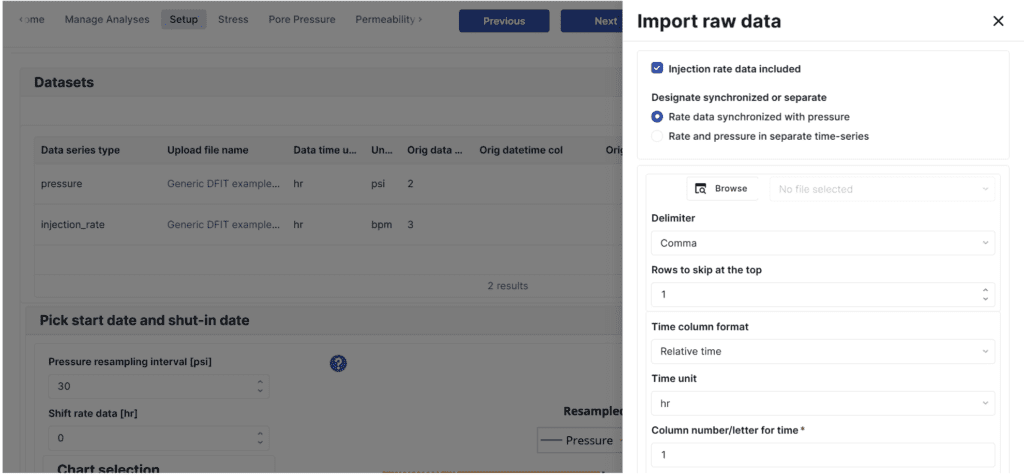
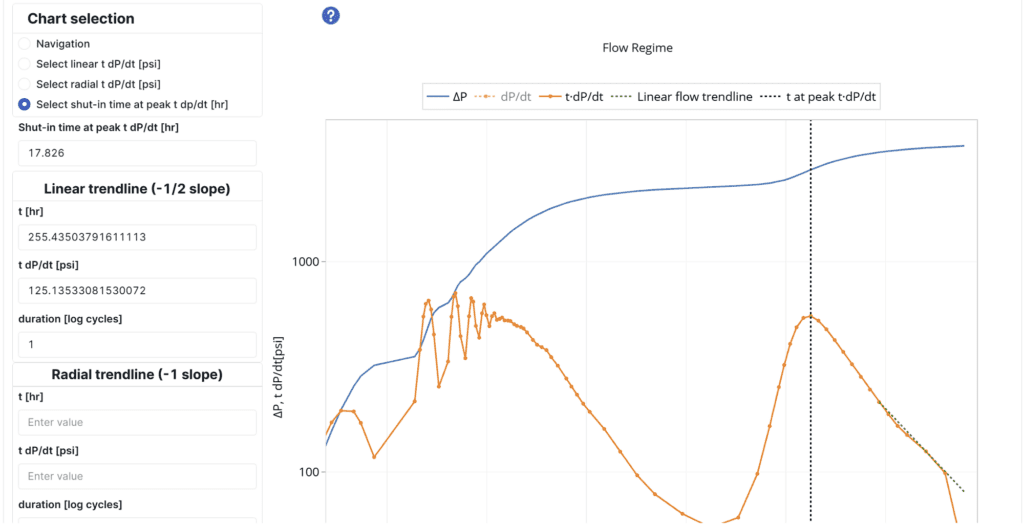
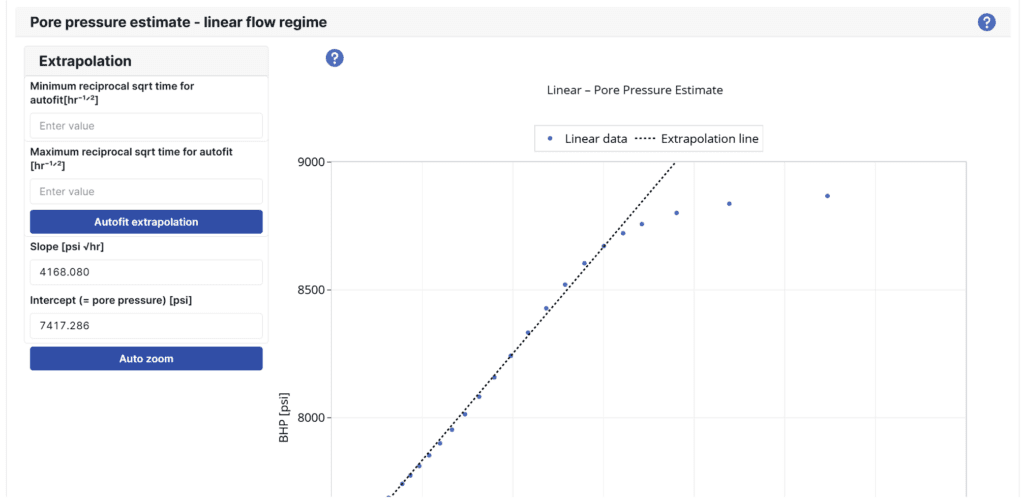
- Web based interface with a series of panels to step through data import, plotting, stress estimation, pore pressure estimation, and permeability estimation.
- Tools to smooth data, generate plots, pick key points, and diagnose flow regimes.
- Workflow that adapts to guide the analysis based on user-selected interpretations.
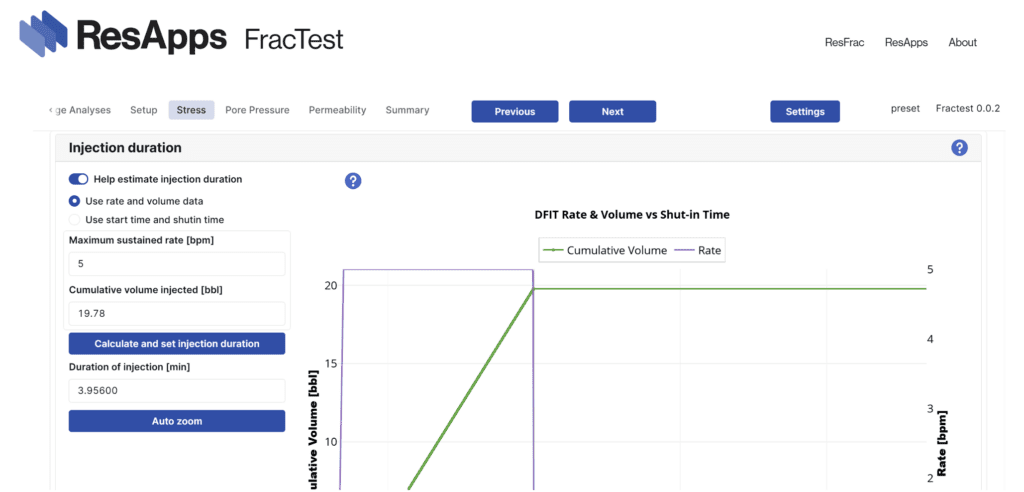
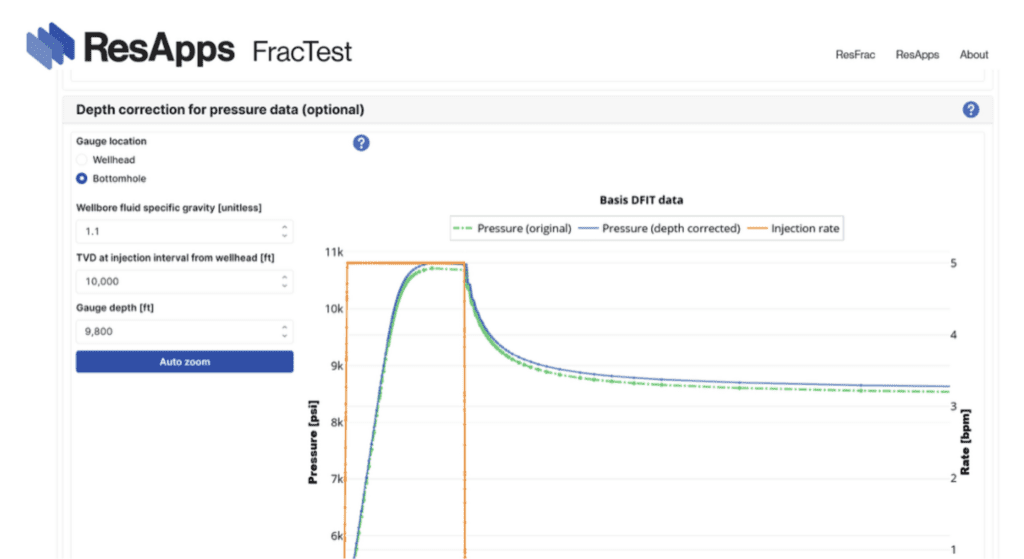
- Built-in wizards to enable quick calculation of supplementary quantities in the analysis – injection volume, wellbore storage, depth adjustment for the gauge, and truncating datasets to remove invalid data.
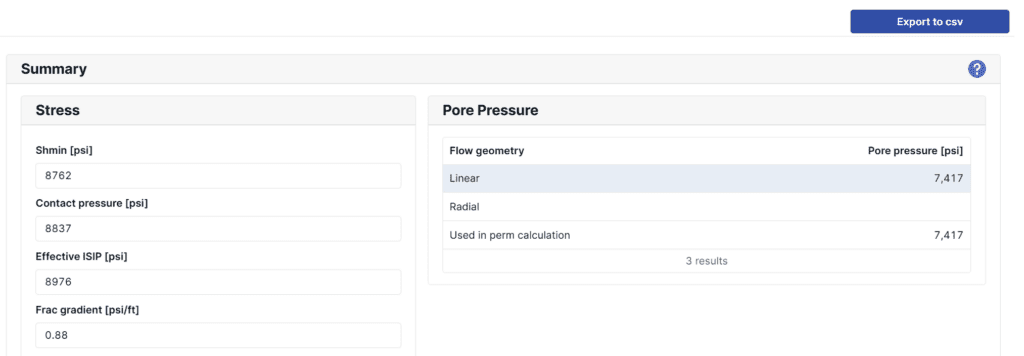
- A summary panel with an export feature to communicate results.
Please contact us if you are interested in using! We can provide a demo video and explain the licensing options.
Below, we have provided some screenshots to show what the app looks like in-action.
References
Barree, R. D., V. L. Barree, and D. Craig. 2007. Holistic Fracture Diagnostics. Paper presented at the SPE Rocky Mountain Oil and Gas Technology Symposium, Denver, Colorado, USA, 16-18 April. SPE-107877-MS.
Castillo, J. L. 1987. Modified Fracture Pressure Decline Analysis Including Pressure-Dependent Leakoff. SPE 16417. Paper presented at the SPE/DOE Low Permeability Reservoir Symposium, Denver, CO.
Craig, David P., Michael J. Eberhard, Robert D. Barree. 2000. Adapting High Permeability Leakoff Analysis to Low Permeability Sands for Estimating Reservoir Engineering Parameters. Paper presented at the Rocky Mountain Regional/Low Permeability Reservoirs Symposium, Denver, Colorado, USA, March 12-15. SPE-60291-MS.
Mayerhofer, M. J., C. A. Ehlig-Economides, and M. J. Economides. 1995. Pressure Transient Analysis of Fracture Calibration Tests. SPE 26527. Journal of Petroleum Technology 47 (3): 231-236.
McClure, Mark W., Hojung Jung, Dave D. Cramer, and Mukul M. Sharma. 2016. The Fracture-Compliance Method for Picking Closure Pressure From Diagnostic Fracture-Injection Tests. SPE Journal 21(4): 1321-1339. SPE-179725-PA.
McClure, Mark, Vidya Bammidi, Craig Cipolla, Dave Cramer, Lucas Martin, Alexei A Savitski, Dave Sobernheim, and Kate Voller. 2019. A Collaborative Study on DFIT Interpretation: Integrating Modeling, Field Data, and Analytical Techniques. Paper presented at the Unconventional Resources Technology Conference, Denver, Colorado, USA, July 22-24. URTeC-2019-123.
McClure, Mark, Garrett Fowler, and Matteo Picone. 2022. Best Practices in DFIT Interpretation: Comparative Analysis of 62 DFITs from Nine Different Shale Plays. Paper presented at the International Hydraulic Fracturing Technology Conference and Exhibition, Muscat, Oman, January 11-13. SPE-205297-MS.
McClure, Mark, Dave Ratcliff, Ankush Singh, Chris Ponners, and Garrett Fowler. 2024. Practical guidelines for DFIT interpretation using the ‘compliance method’ procedure from URTeC-2019-123. EarthArXiv.
Nolte, Kenneth. 1979. Determination Of Fracture Parameters From Fracturing Pressure Decline. Paper presented at the Annual Fall Technical Conference and Exhibition of the Society of Petroleum Engineers, Las Vegas, Nevada, USA, September 23. SPE-8341-MS.
Valko, P. P. and M. J. Economides. 1999. Fluid-Leakoff Delineation in High-Permeability Fracturing. SPE Production & Facilities 14 (2), doi: 10.2118/56135-PA.
Xia, Shufan, and Mark W. McClure. 2026. Statistical Review of 225 Diagnostic Fracture Injection Tests from the Montney Shale. Paper presented at the Hydraulic Fracturing Technology Conference, The Woodlands, TX, USA, February 3-5. SPE-230650-MS.