
This week, I attended ResFrac customer Fervo Energy’s IPO on the Nasdaq. The positive energy was incredible. Roughly 100 people were there: Fervo employees, family, and members of the wider Fervo-supportive community.
I was invited because ResFrac provides our software and services to Fervo (see this paper for a case study), and also because I have been an advisor to the company since before its founding. As Jack reminded me this week, I introduced him and Tim! They founded Fervo around the same that ResFrac was being first released commercially, and they played an important role for our company because they were one of our earliest customers, and in turn, we were one of their first partners and vendors. Ever since then, ResFrac has been a core part of Fervo’s workflow in doing stimulation design and reservoir engineering.
As I reflect on how far both ResFrac and Fervo have come since then, it’s a crazy feeling. We are ‘living in the future,’ as things that once felt like distant goals have become a reality.
Fervo started with a strong idea – that modern hydraulic stimulation techniques should be able to greatly outperform the stimulation designs that had been traditionally used in Enhanced Geothermal Systems (EGS). Since then, their execution on that vision has been extraordinary. There are so many things that they have had to get right – drilling, permitting, surface facilities, stimulation design and reservoir engineering, geoscience, fund-raising, communication with stakeholders, legal, and on and on. They’ve delivered by assembling a ridiculously talented, hard-working, and committed team, and establishing a strong company culture. It’s hard to imagine anyone else pulling this off – Tim and Jack were the perfect people to found Fervo. Their combination of skills, background, attitude, and talent is one-of-a-kind.
I am constantly impressed by the Fervo team. For example, another key person is Christian Gradl, who was Fervo’s first hire. He left a senior position at Hess to join what was then a two-man startup. He’s been very important in the practical aspects of well construction and completion design, which has been critical, considering the number of first-ever designs Fervo has had to execute.
This week at the IPO, I reconnected with Doug Hollett. Doug was the Director of Geothermal Technologies at the Department of Energy when the FORGE project was first conceived. He and Lauren Boyd (who is the current director of the Office of Geothermal) did the heavy lifting to convince congress to fund the FORGE project. In 2014, the DOE put out the first FORGE FOA and explicitly said that they wanted to drill horizontal/highly deviated wells and use multistage fracturing. Back then, there were a lot of old-school EGS people who were very skeptical of this approach. But when the DOE put its backing behind the concept, it began to be taken much more seriously.
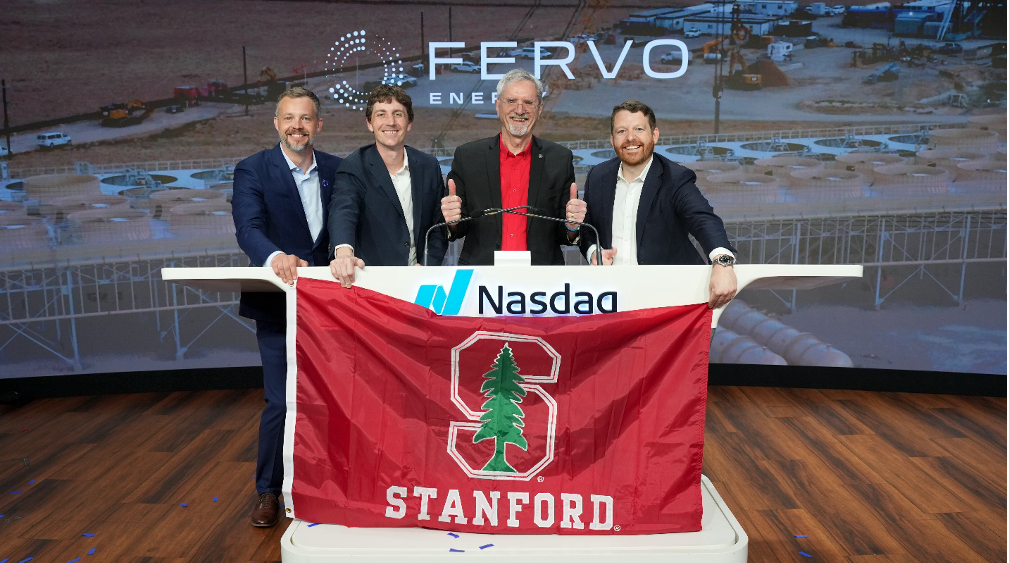
Another attendee was Roland Horne, leader of the Stanford Geothermal Program, and PhD advisor to both Jack and me for our PhD research on EGS. Roland brought a Stanford flag, and during the photo period after the ‘opening bell’ ceremony, he unfurled it for the ‘Stanford’ photo shown below! Jack and I graduated from the ERE department, and Tim graduated from the business school. One other Stanford person attending – Dave Danielsen from early-investor Breakthrough Energy Ventures and instructor for Stanford Climate Ventures, a climate tech startup class that helped Tim and Jack get started.
A funny tidbit – there were four people at the IPO who graduated from St. John’s School in Houston, TX – myself, SVP Sarah Jewett, chief-of-staff and advisor Gabe Malek, and Nick Dhesi (partner at Latham who helped lead the IPO). Great showing for a school whose mascot is the ‘Mavericks!’
The IPO itself exceeded Fervo’s expectations. They wound up raising much more than originally planned, at above their original price target. Then, on the day of the IPO, the stock rose another 33%. With the oversubscribed round, the company raised around $2 billion. The funding will enable them to expand their current Project Cape and advance through their pipeline of projects, with Project Blanford coming up next. Operating at greater scale is allowing them to drive down costs and move along the learning curve, just like Tim predicted in his 2017 Stanford Geothermal Workshop paper, which he wrote the year he founded Fervo.
Beyond Fervo, what else is happening in the EGS space? There are several recently formed startups with strong teams and fund raising. Fervo’s validation of technical and commercial feasibility will make it much easier for others to follow a similar path. Also, the oil and gas industry is paying attention. Many of the largest oil and gas companies are taking steps to evaluate EGS and prepare to pursue development. As this ecosystem grows, I am optimistic that the various players see that the advantages of collaboration outweigh the perceived benefits of being secretive. First, because the larger the market, the more that service companies will be willing to invest in tools and technology. Second, because everyone will benefit from traveling along a collective learning curve. As noted by Greg Leveille in his recent SGW paper, “one of the principal factors [in the success of shale] was the transfer of technical knowledge between operators.” We see this today in the shale industry, where – with a few notable exceptions – operators are collaborative and relatively open about sharing learnings.
From the ResFrac perspective, we have never been busier on EGS. For years, Fervo was our only geothermal client. Now, the number of companies using ResFrac for EGS work has reached double-digits, and there are many more users in universities and national labs. The essential core of EGS is that hydraulic stimulation must be used to create permeability. Optimization of that hydraulic stimulation process is our specialty at ResFrac. Our technology, experience, and understanding of stimulation processes in EGS are distinctive.
We are working hard to keep improving, with upcoming EGS features such as: complex discrete fracture geometries, distributed memory parallelism for larger and faster simulations, an overhauled geothermal economics module, and fully coupled reactive transport modeling.
I am excited to see what the future holds. For today, as Jack and Tim like to say, let’s “stop and smell the roses” and toast Fervo for their great accomplishments and successful IPO.