
Introduction
Recently, ‘water loss’ has been a hot topic of discussion for EGS. Fervo reported that they have been producing only 70% of the fluid volumes that they have been injecting at their Project Red. The FORGE project reported a roughly 10% water loss rate. Because projects will have finite water rights, these results have led to concern that growth of EGS will be limited by excessive water consumption.
This is a valid concern, and water availability is a legitimate factor in site-selection and project engineering. However, I believe that the problem has been overstated. Some key points:
- Water loss is strongly controlled by well configuration. If injection wells are surrounded on either side by production wells, then net water loss will be much lower.
- Because EGS can use brackish water, it can tap water sources that are unusable for other purposes.
- If needed, production pumps could be used on outer production wells, resulting in the ability to bring projects to very low or net zero water injection.
In this post, I step through ResFrac simulations showing how well configuration and drawdown strategy impact water consumption.
Simulating different scenarios
The FORGE and Fervo cases reported to-date have been small-scale pilots. None of them have had injectors bounded by producers. Project Red and FORGE have doublets, and Fervo’s reported Project Cape flow test was a triplet with injectors on the outside. How would results have changed with bounded injectors?
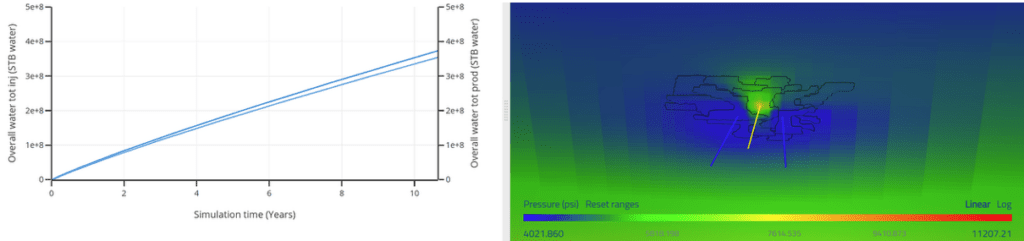
I ran ResFrac simulations to investigate. The figure below shows an EGS simulation that is roughly based on the geologic conditions of Fervo’s Project Cape and the Utah FORGE project. The right panel shows the distribution of pressure in the fractures and the surrounding matrix. The left panel shows total cumulative water injection and production.
The system is a three-well triplet, with the injection wells placed on the outside. The producer is wine-racked to be slightly shallower than the injectors. I used a large mesh so that the edges of the matrix region are far from the wells. At the top and sides, I specified constant pressure boundary conditions.
The ‘system permeability’ of the background rock is set to 80 microdarcy. This is a much higher permeability than the intact granite/gniess of the site. The elevated permeability represents the contribution to the ‘system permeability’ that comes from the natural fractures in the formation. This value is ‘order of magnitude’ consistent with what is needed to match frac diagnostics and is consistent with the ‘rapid closure’ response seen in the DFITs performed at the site.
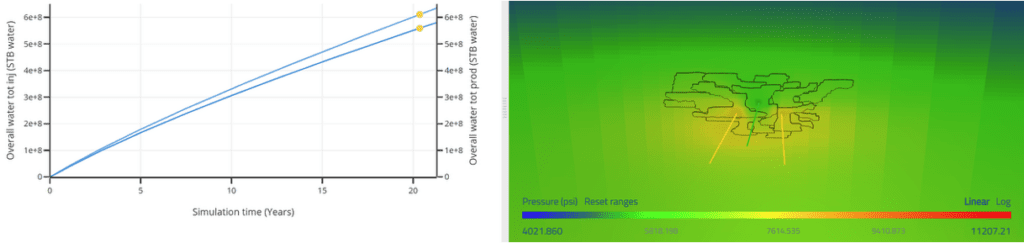
After 2 years, the net fluid loss is 7% (ie, the total production is 7% lower than the total injection). At 10 years, the fluid loss is 7.6%. This is significant water loss. Because the injectors are unbounded, fluid is able to leak off into the far-field.
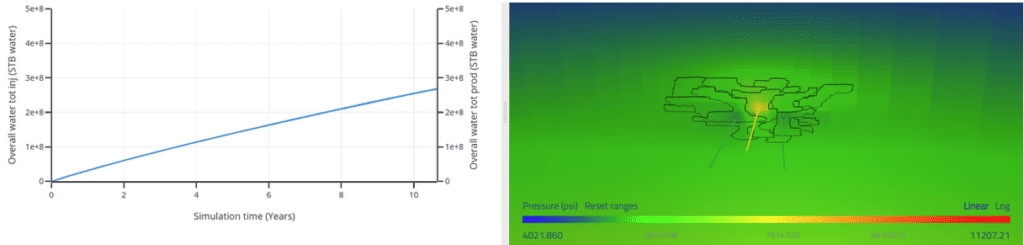
Next, I ran a simulation where I flipped the assignments of the injectors and producers. The inner well is an injector, and the outer wells are producers. With this new configuration, shown below, the net water loss is dramatically lower – 0.3% at 2 years and 0.9% at 20 years.
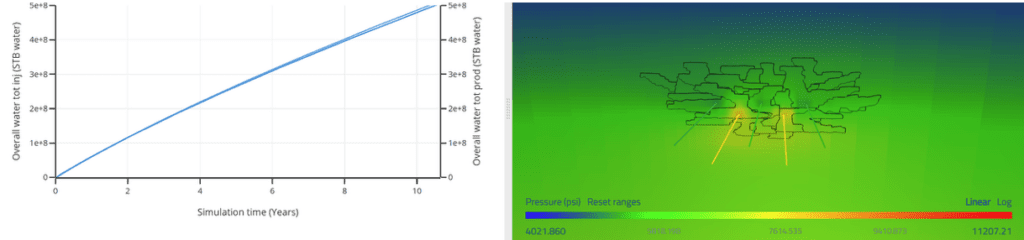
To test a larger-scale well configuration, I ran a simulation with five wells – producers on the outside and in the middle, and injectors in-between. The fluid loss is 0.3% at 2 years, and 1.5% at 10 years.
It has been suggested that pumps should be used on the production wells to reduce fluid loss. In the simulation below, I reran the ‘outer injector’ scenario, but with a significantly lower BHP, corresponding to a pumped production well. The net fluid loss is 3.2%. That is a 43% reduction from the original ‘outer injector’ scenario, but still, significantly more fluid loss than the ‘outer producer’ scenario.
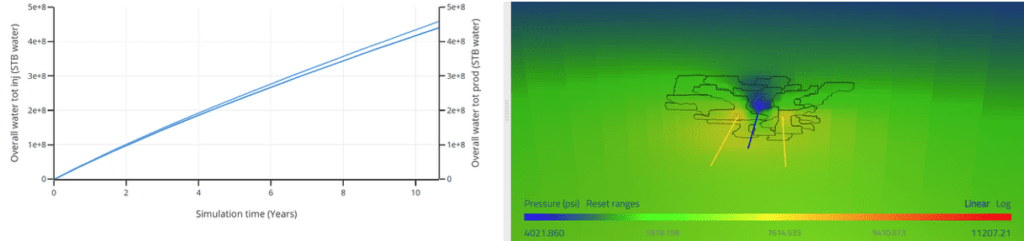
Next, I ran a simulation with production wells on the outside, and with pumps placed in the production wells. Now, there is net production of fluid – 6% at 2 years, and 5% at 10 years. Net production occurs because the production wells are drawn down below reservoir pressure, and so they pull fluid in from the surrounding formation. In reality, an operator would not typically want to produce more than it injects. The pumping of the outer wells could be reduced to bring net injection/production to zero.
Discussion
Aside from affecting fluid loss, I think the jury is out on whether it will prove optimal to use pumps on production wells for EGS. Lowering the bottomhole pressure will apply more drawdown, which should increase flow rate. However, fracture conductivity is stress-sensitive, and so decreasing the BHP will reduce fracture conductivity. As a result, some of the benefit of the greater drawdown will be lost to reduced capacity for flow. I look forward to seeing tests with pumped EGS production wells in the future, because we’ll get field data to quantify the magnitude of this effect.
My colleague Koenraad Beckers suggested a few other points. He pointed out that EGS can use brackish water, and so it is not competing directly with agricultural/human water uses. Similarly, data centers have more stringent water quality requirements for their cooling systems than geothermal. Also, geothermal air-cooled binary power plants lose zero water at the surface. In contrast, traditional thermal power plants (nuclear, coal, and natural gas) usually consume water in their cooling towers.
Wrap-up
To recap – yes, fluid loss is high in the published field data so far. However, at-scale, there will be alternating producers/injectors, and producers can be placed on the outside. With this configuration, fluid loss will be much lower. If needed, pumping could be performed in the outer production wells to further reduce fluid loss, and potentially to bring net fluid loss to zero.
Fluid loss definitely a topic worth keeping an eye on – especially for pilot projects that have only a doublet – but the issue will greatly diminish for larger-scale projects.