
About

Mark Zoback

Senior Executive Advisor

Mark Zoback is the Benjamin M. Page Professor of Geophysics and the Director of the Stanford Natural Gas Initiative at Stanford University.

He co-directs SCITS Stanford Center for Induced and Triggered Seismicity (SCITS) and the Stanford Center for Carbon Storage (SCCS). Dr. Zoback conducts research on in situ stress, fault mechanics, and reservoir geomechanics. He is the author/co-author of over 300 technical papers, holder of five patents and author of two books. Reservoir Geomechanics, published by Cambridge University Press in 2007 is now it’s 15th printing. His online course, also entitled Reservoir Geomechanics, has been completed by over 10,000 students around the world.

Mark’s book, Unconventional Reservoir Geomechanics, written with Arjun Kohli, was released by Cambridge Press in April, 2019. Dr. Zoback has received a number of awards and honors, including the 2008 Walter H. Bucher Medal of the American Geophysical Union. In 2011 he was elected to the U.S. National Academy of Engineering and in 2012 was elected to Honorary Membership of the Society of Exploration Geophysics. He was the 2013 recipient of the Louis Néel Medal of the European Geosciences Union and named an Einstein Chair Professor of the Chinese Academy of Sciences. In 2015 he received the Robert R. Berg Outstanding Research Award of the AAPG and in 2016 received the Outstanding Contribution to the Public Understanding of the Geosciences Award from the American Geological Institute.

Mark's posts

Abstract illustration with multiple outlined maps over a green-to-yellow gradient and light beams.

The influence of well configuration on water loss in Enhanced Geothermal Systems

Recently, ‘water loss’ has been a hot topic of discussion for EGS. Fervo reported that they have been producing only 70% of the fluid volumes that they have been injecting at their Project Red. The FORGE project reported a roughly 10% water loss rate. Because projects will have finite water rights, these results have led to concern that growth of EGS will be limited by excessive water consumption. This is a valid concern, and water availability is a legitimate factor in site-selection and project engineering. However, I believe that the problem has been overstated.
Read more
Large conference room with a speaker presenting a slide deck to an audience seated around circular tables.

2026 ResFrac Annual Symposium Recap

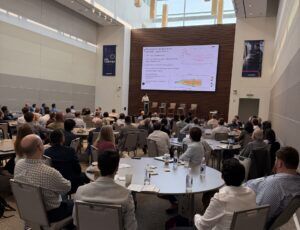
On June 25, 2026, we got the ResFrac community together both in-person at the ExxonMobil campus in Spring, Texas, and virtually around the globe for our Annual Symposium. With our community growing as fast as it is, the energy in the room was absolutely buzzing. We had a jam-packed day of operator case studies, deep-dive technical sessions, and some incredible geomechanical insights from industry legends.

Read more
ResApps FracTest interface showing a Stress interpretation section with an Auto-interpret button and contact options, next to a Stress Diagnostic Chart.

FracTest – An Online Tool for DFIT Interpretation

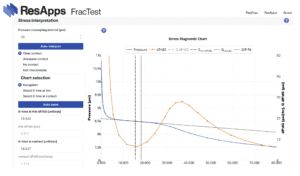
This week, we are releasing FracTest, a web-based application for interpretation of diagnostic fracture injection tests (DFITs). FracTest is available at resapps.resfrac.com, alongside our other two ResApps, StageOpt and IntTest. DFITs are small-volume fracture injection tests used to estimate stress, pore pressure, and permeability. These quantities form the foundation of the fracture and reservoir engineering work that we do in ResFrac, and so we view DFIT interpretation as one of the most important parts of our workflow.

Read more

Meet the ResFrac team

Learn why both independents and supermajors trust ResFrac

Search