
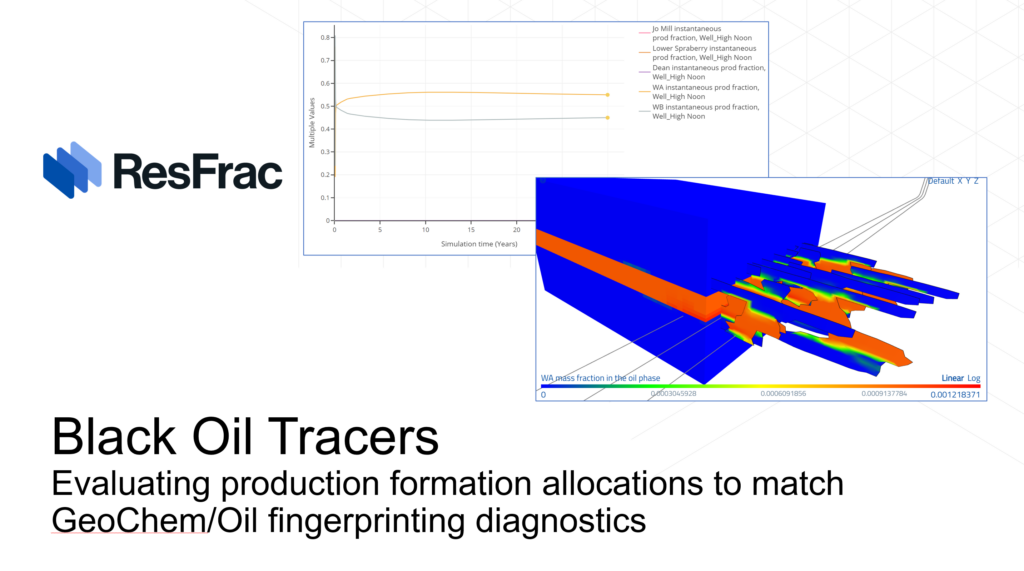
Black oil tracers can be used to obtain an exact allocation of production by layer. This document explains how the capability works and how to implement it within the black oil model.
Typically, the black oil model has three fluid “components” — water, oil, and gas. Note that the oil and gas “components” may both be soluble in the oil and gas phases.
With the “black oil tracers” capability, you can define additional components in the black oil model. The simulator fully tracks mass balance for these components, just like any other component. For purposes of calculating fluid properties, the black oil tracer components are treated as either identical to the “oil” component or the “gas” component.
This capability enables fully exact allocation of production by layer into each individual well. Previously, approximate methods were used to create flow allocations. We have previously had approximate methods for creating flow allocations. We now can create fully exact flow allocations by layer by well.
First, define the names of the “black oil tracer components.” There is no technical limit to how many can be defined; however, simulation time increases as the number of components increases. We recommend defining no more than 5–10 tracer components.
By default, these black oil tracer components are considered identical to the ‘oil’ component, not the ‘gas’ component. However, you can optionally make some or all of them identical to the ‘gas’ component. To do that, specify ‘black oil tracer partitioning’ as either oil or gas.
“Black oil tracer mass fractions” specify how the simulation is initialized. You assign the mass fraction of each tracer to each layer. When the simulation is run, you can plot the fraction of each tracer in the produced fluid for each well, enabling flow allocation by layer.