
At the 2025 SPE International Hydraulic Fracturing Technology Conference, we (Dontsov, Zoback, McClure, and Fowler) presented “Hydraulic Fracture Propagation Along Bedding Planes Might Be More Prevalent Than We Think” (SPE-226637). The paper reviewed case studies with evidence of horizontal or bedding plane fractures from microseismic, fiber optics, core observations, and casing deformation.
- Marcellus Shale: Microseismic clouds constrained in height at the toe of the well suggested horizontal fractures, which was confirmed by the observation that the ISIP exceeded the vertical stress in these stages. (Alalli and Zoback, 2018)
- Eagle Ford: A vertical core recovered a propped horizontal fracture, even though the overall stress regime was normal faulting. (Courtesy of Von Gonten Engineering )
- Sichuan Basin: Fiber optic monitoring revealed both vertical and horizontal fractures propagating simultaneously, with horizontal fractures showing opening and slip behavior. (Wang et al., 2025)
- Numerous casing deformation cases (Vaca Muerta, Montney, Duvernay, Midland, Anadarko, etc.) suggest bedding-plane slip triggered by sub-horizontal fracture propagation. (Uribe-Patino et al., 2024).
Conventionally, we might expect horizontal or subhorizontal fractures to only form in reverse faulting regimes, when the minimum principal stress is vertical. However, these fractures can also form normal and strike-slip faulting regimes because the stress shadowing from vertical fractures increases the horizontal stresses more than the vertical stresses. Eventually, sufficient horizontal stress can build up such that the fluid pressure exceeds the overburden.
Fluid loading per reservoir volume, well density, and well sequencing can all increase the propensity to initiate and propagate bedding plane fractures. Also, horizontal fractures are more likely to form when the stratigraphy causes unusually high stress layers to be present, even if they are relatively thin.
Bedding plane fractures coexist with vertical fractures, as shown by Wang et al. (2025). The relative partitioning of deformation into horizontal and vertical components depends on the stress state, frac design, and other factors.
Vertical fractures contribute directly to hydrocarbon production by connecting reservoir layers. Conversely, horizontal fractures are less likely to contribute to production because vertical permeability is usually significantly lower than horizontal. Also, subhorizontal fractures cause casing deformation, and create unintended hydraulic connectivity between wells.
Simulating horizontal fractures – base case
To build on the field observations compiled in SPE-226637, we ran a series of production-focused simulations designed to test how horizontal fracture propagation impacts well performance.
Figure 9 of SPE-226637 features a simulation built from the build-in Eagle Ford simulation template, with an “average” type completion design: 200 ft stage with 8 clusters, completed with 40 bbl/ft of slickwater and 1800 lbs/ft of a mix of 100 mesh and 40/70 mesh sand.
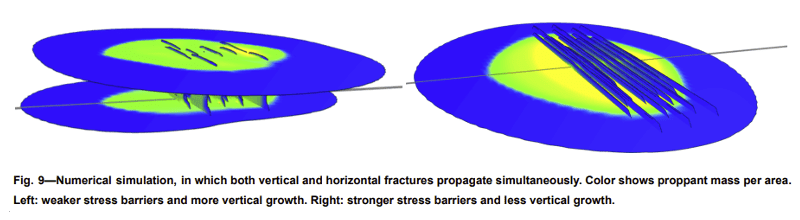
The initial stress state in the model corresponds to a normal faulting regime, i.e. $S_h < S_H < S_v$. However, as explained in the paper, stress shadowing can increase Sh and SH and push the rock into a strike-slip regime, introducing a potential competition between vertical and horizontal fracture propagation (when the tensile strength of the rock is taken into account).
The resulting simulation exhibits the presence of both vertical and horizontal fractures. In the image below I’ve stretched the image in both Sh (along wellbore strike) and vertical directions:
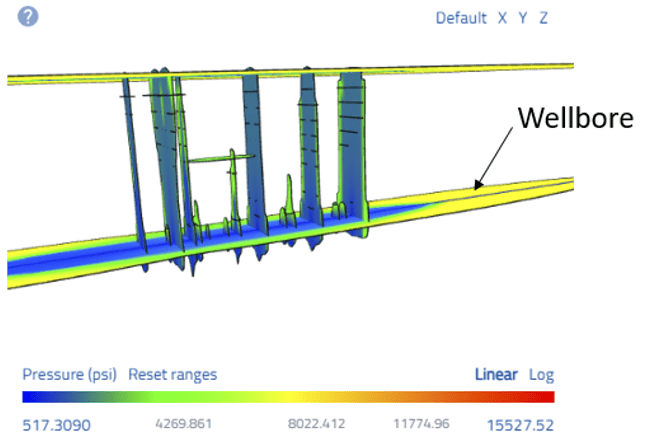
We observe horizontal fractures dominating at two depths:
- At the depth of the wellbore where stress shadowing is largest
- At the top of the zone where Sh increases (frac barrier)
Stress Sensitivity
The closer Sh is to Sv, the more likely it is for Sh + Th to exceed Sv + Tv and allow horizontal fracture initiation (where Th and Tv are the effective tensile strengths in the horizontal and vertical directions, respectively). Starting from the base stimulation, we ran a sensitivity of gradually increasing Sv. When vertical stress (Sv) is relatively low (≈1.10 psi/ft), bedding-plane slip is more likely, leading to a higher proportion of horizontal fracture area. This limits effective contact with the reservoir. As Sv is increased toward 1.125–1.15 psi/ft, more fracture energy is directed into vertical fracture growth, which increases productive surface area in the pay zone and improves oil recovery.
The figure below shows results of simulations for different values of Sv gradient. The top pictures show the resulting fracture geometry, while the bottom picture depicts oil production. Note that line colors correspond to different vertical stresses, as is also indicated on the top pictures.
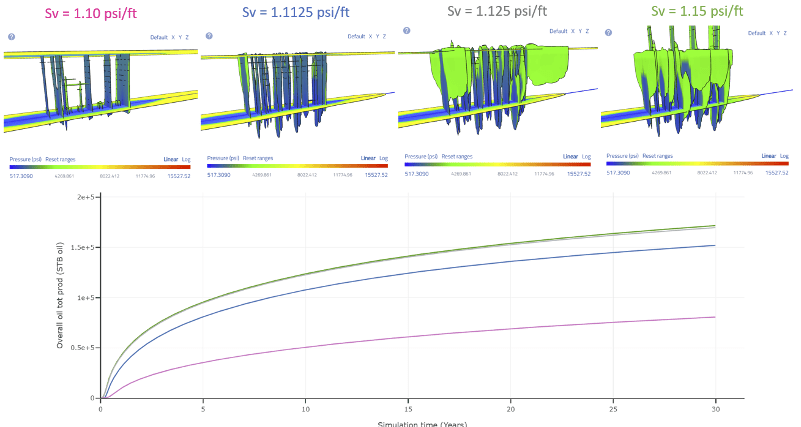
There is approximately a 2x difference between the low and high Sv cases because of the generated vertical fracture area.
From an engineering perspective, we cannot change the initial stress state of the rock; however, the simulations above demonstrate that significant production potential may be being lost to horizontal fractures. There may be scenarios where targeting a lower porosity/permeability landing zone could be superior to a higher quality landing if the lower quality landing target is in a lower stress zone.
Fluid Loading Tradeoffs
To evaluate how engineering decisions may impact productivity in these plays, I ran a series of simulations varying injection volume (keeping proppant concentration constant). Typically, we would expect that increasing injection volumes should increase production, especially from a standalone well. The economic optimum is then determined by diminishing returns – when the cost of fluid and proppant exceeds the incremental oil/gas production. In our case, where horizontal fractures compete with vertical fractures, fluid injection intensity also strongly controls the balance between vertical and horizontal fractures.
The figure below shows that oil productivity increases as injection volumes are increased from 25 to 55 bbl/ft; however, beyond 55 bbl/ft, increasing injection volumes decreases oil production.
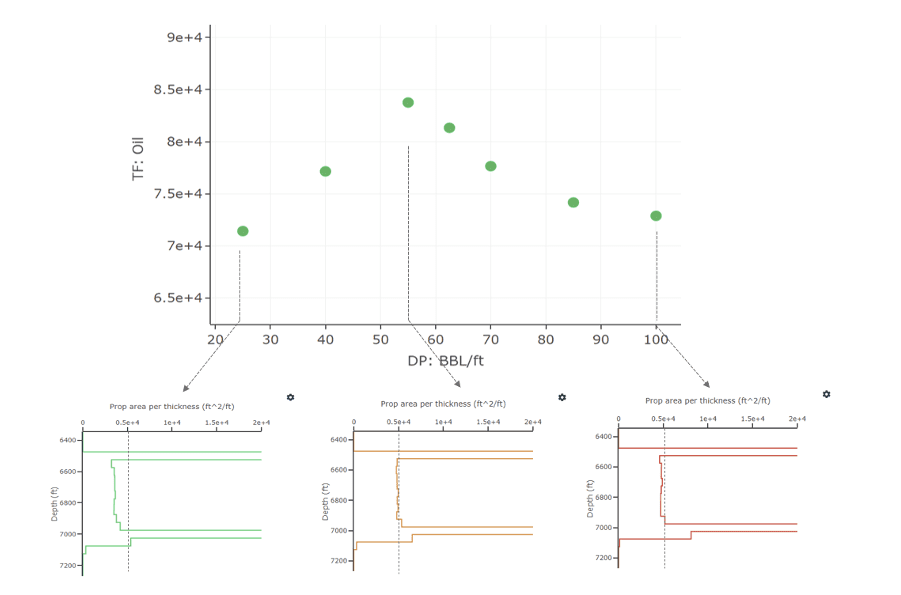
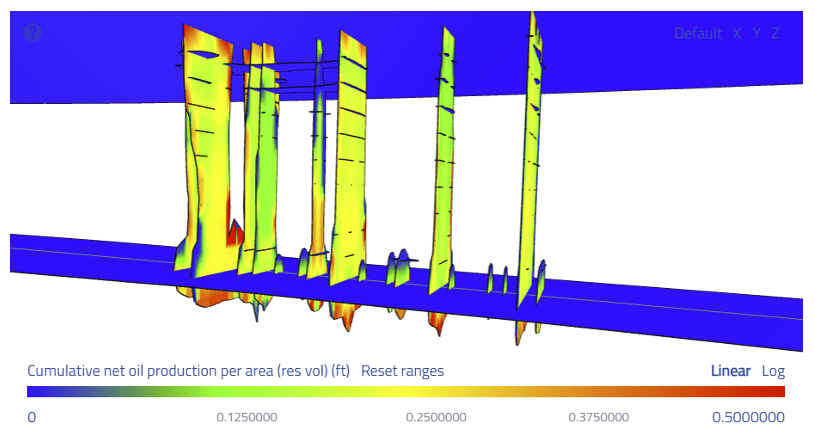
The plots at the base of the image show the propped area versus depth. We observe that between 25 and 55 bbl/ft, the propped area is increasing, but beyond 55 bbl/ft, the created propped area plateaus (the spikes at the top and bottom of these charts correspond to the horizontal fractures). For this model, increasing injection above 55 bbl/ft does not increase the propped area in the vertical fractures, but only increases the extent of the horizontal fractures, resulting in no addition to the productive fracture area. The image below shows the distribution of productive fracture area at the end of 30 years, with warmer colors corresponding to fracture regions that have produced the most oil. We observe that nearly zero oil production comes from the horizontal fractures, with the production focused near the vertical fractures around the wellbore.
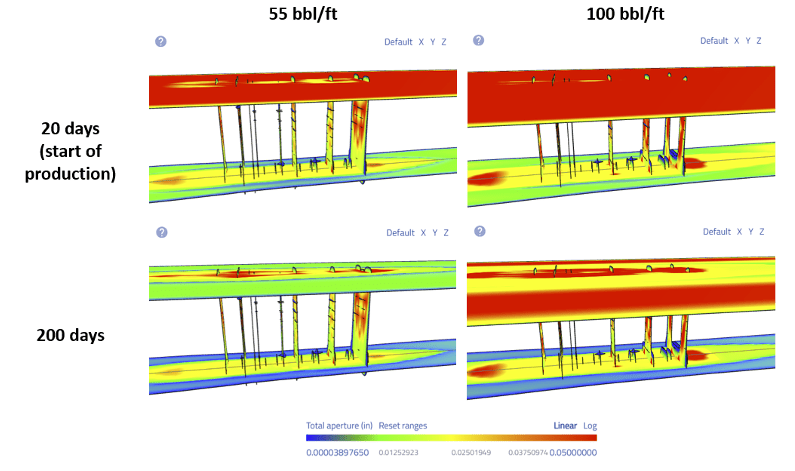
The additional water pumped in completions larger than 55 bbl/ft is primarily diverted into horizontal fractures, with low leak-off. then inhibits oil production. The figures below compare the aperture inside the fractures at 20 and 200 days. We observe that at 55 bbl/ft, the fracture apertures start smaller and reduce faster than in the 100 bbl/ft scenario.
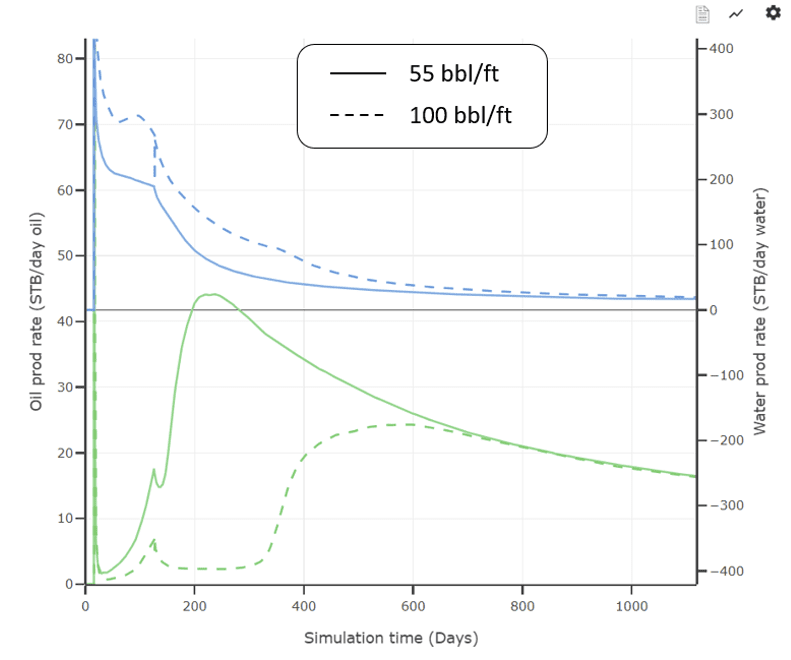
The stranded water in the 100 bbl/ft scenario inhibits oil production. Comparing 55 bbl/ft to 100 bbl/ft, we observe that the water production remains much higher in the 100 bbl/ft scenario than the 55 bbl/ft scenario for the first 400 days of production. This water production is being fueled by the horizontal fractures and comes at the expense of oil production.
Another important finding of the sensitivity is that the optimal result (55 bbl/ft) still exhibits extensive horizontal fractures because between 25 and 55 bbl/ft the extent of vertical and horizontal fractures were both growing. The 55 bbl/ft scenario would likely increase geomechanical risks, which would need to be evaluated in the context of the particular setting, but production is not maximized by minimizing horizontal fractures. This is an important point as there are reservoir targets where it may be impossible to not initiate horizontal fractures during stimulations, but that should not exclude those targets from consideration.
Conclusions
The simulations reinforce the takeaway from SPE-226637: horizontal fractures are not rare anomalies, but a predictable outcome when rock fabric and operations align in certain ways. Evaluation of geologic/geomechanical settings and design decisions is imperative for maximizing value in these complex systems. In some plays, there may be a narrow operational window that maximizes productivity. Staying within this window requires balancing fluid intensity and other design considerations against the local stress profile.
Donstov et al. (2025) called for tailoring treatments to local rock properties to avoid unintended horizontal fractures. These new simulations show why: the difference between strong vertical fracture networks and counterproductive horizontal growth can hinge on just a few hundred psi of stress or a few barrels per foot of fluid loading.
For operators, this suggests that a more nuanced design approach—calibrated to stress, anisotropy, and loading—offers both higher production and lower risk of casing deformation.
References
Alalli, A.A. and Zoback, M.D., 2018. Microseismic evidence for horizontal hydraulic fractures in the Marcellus Shale, southeastern West Virginia. The Leading Edge, https://doi.org/10.1190/tle37050356.1.
Dontsov, E. V., Zoback, M. D., McClure, M. W., and G. J. Fowler. Hydraulic Fracture Propagation Along Bedding Planes Might be More Prevalent than We Think. Paper presented at the SPE International Hydraulic Fracturing Technology Conference and Exhibition, Muscat, Oman, September 2025. SPE-226637-MS.
Uribe-Patino, J. Uribe-PatinoA., Casero, A., Dall’Acqua, D., Davis, E., King, G.E., Singh, H., Rylance, M., Chalaturnyk R. and Zambrano-Narvaez, G., 2024. A Comprehensive Review of Casing Deformation During Multi-Stage Hydraulic Fracturing in Unconventional Plays: Characterization, Diagnosis, Controlling Factors, Mitigation and Recovery Strategies. Paper presented at the SPE Hydraulic Fracturing Technology Conference and Exhibition, The Woodlands, Texas, USA, SPE-217822-MS, 10.2118/217822-MS.
Wang, W., Mjehovich, J., Chen, L., Jin, G., Li, J. and Fu, X., 2025. Bedding Plane Slippage and Fault Reactivation Captured by Cross-Well LFDAS Monitoring During Hydraulic Fracturing. Paper presented at the SPE Hydraulic Fracturing Technology Conference and Exhibition, The Woodlands, Texas, USA. SPE-223538-MS.