
Introduction
What controls proppant placement during hydraulic fracturing?
As described in Chapter 8 from McClure et al. (2025), ResFrac incorporates a variety of physical processes – viscous drag, gravitational settling, hindered settling, clustered settling, bed slumping, and more. In addition, ResFrac accounts for the complex physics associated with proppant flowing out of the wellbore (Dontsov, 2023; Ponners et al., 2025).
The original ResFrac proppant trapping formulation was based on an extensive literature review. Over time, experience has led us to make further improvements. In 2019, we made a significant change, introducing what we call ‘proppant trapping’ or ‘proppant immobilization’ (McClure et al., 2020). The concept is that as proppant travels through the fracture, some of it is held up on asperities, ledges, and other forms of non-ideal geometry and roughness. When the proppant is held up, it is prevented from traveling further out into the fracture or settling to the bottom. Although this concept is not found in textbooks on hydraulic fracturing, we have come to believe that it is foundational to explaining how proppant is placed in shale.
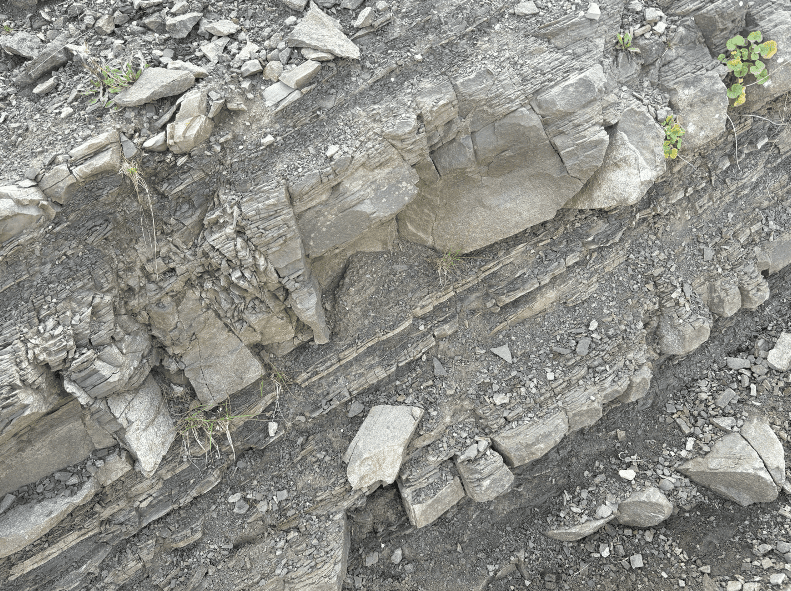
I took the picture below of a laminated shale that I saw hiking in the Alps this summer. The theory of ‘proppant trapping’ is that as fractures propagate through these formations, laminations and other heterogeneities lead to irregularities that cause proppant to become immobilized. Examples can be seen in the core-through described by Gale et al. (2018).
In this post, I outline the motivation and formulation for ResFrac’s proppant trapping model. Next, I describe a newly developed extension to the proppant trapping model that was developed by Serhii Kryvenko (2025). His new formulation accounts for the effect of grain size, proppant density, fluid viscosity, and flow velocity.
Our goal with ResFrac is to harmonize physics, laboratory measurements, and empirical observation. Many field-scale processes cannot be reproduced in the lab, and direct in-situ measurements are the only way to calibrate a model of their behavior. To constrain our understanding of proppant transport, we use interference tests, production history matching, geochemical analysis, and far-field pressure measurements (Albrecht et al., 2022; Ponners et al., 2024; Singh et al., 2025). When proppant trapping is stronger, the thickness of the proppant in the propped area becomes greater, which results in a smaller propped surface area. By calibrating the parameter ‘maximum immobilized proppant’ to field data, we have found that it falls within a relatively narrow range, of around 0.07-0.25 lbs/ft^2. Within a particular shale play, the ‘maximum immobilized proppant’ is relatively consistent.
While this empirical approach has worked well, it is somewhat limited in its ability to extrapolate outside the training data and to predict the response to changing conditions. We should reasonably expect that parameters such as grain size, grain density, or flow rate might affect proppant immobilization. For example, Singh et al. (2025) found that far-field pressure measurements could be best-described by assuming that more trapping occurs for larger diameter particles.
The Kryvenko correlation starts from a physical basis and develops equations that generalize the trapping model predict proppant trapping as a function of a broad set of physical variables. As shown in the simulations below, it captures a variety of trends that we suspect may be present in the data. Nevertheless, further testing will be needed before we’re ready to fully deploy it as part of our core ‘best practices.’
The Original Proppant Trapping Formulation
This section describes the proppant trapping formulation that we have used since 2019. ResFrac models proppant trapping with the equation:
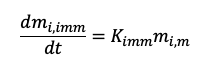
Where $ m_{i,imm} $ is the mass per area of proppant $i, m_{i,m}$ is the mobile mass per area (equal to the total mass per area minus the immobilized mass per area), and $K_{imm}$ is an immobilization rate constant. Typically, $K_{imm}$ is set to a relatively large number so that immobilization is ‘fast.’ The default value is 0.2 min^-1. The value of $ m_{i,imm} $ is permitted to increase until reaching a user-specified maximum value, the ‘maximum immobilized proppant.’ ResFrac allows you to modify the maximum immobilized proppant per area by proppant type or by geologic layer. In ResFrac’s current formulation, once proppant has become immobilized, it will never remobilize under any circumstances.
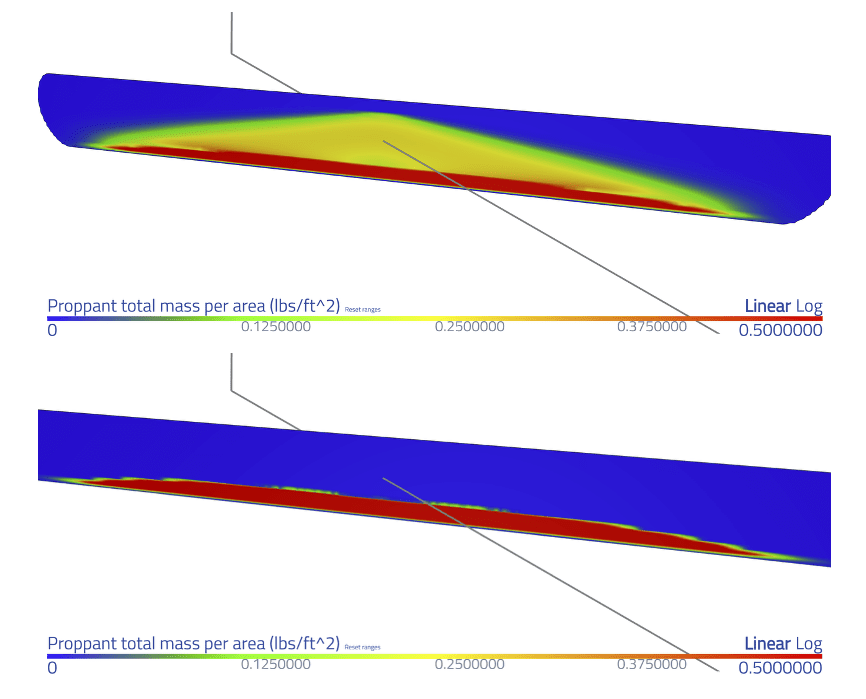
To illustrate why proppant trapping is needed for realistic simulation results, the figure below shows what happens in a simulation that does not include trapping. This simulation shows injection of a 100 mesh proppant in a 1.5 ppg slurry.
The first panel shows the proppant distribution at shut-in. Slurry is traveling laterally from the well, and the proppant is gradually settling downward as it flows away from the well. However, if the permeability is low (such as in shale), it will take hours for the fracture to close after shut-in. The second panel shows the distribution of proppant several hours after shut-in, prior to the closure of the fracture. All of the proppant has settled out to the bottom of the fracture, and none is placed at the well.
In the figures, the color bar maximum is set to 0.5 lbs of proppant per ft^2 lbs. Elements with proppant placement greater than 0.5 lbs/ft^2 are plotted red, since the color range saturates.
This ‘no trapping’ simulation provides a mathematically valid simulation result. However, it cannot be reconciled with actual experience from field data. If proppant settled down to the bottom of the fracture, without placing near the well, then we would see little benefit from injecting proppant. In reality, the opposite is true – large volumes of proppant injection are crucial for maximizing production in the overwhelming majority of shale frac jobs.
One might hypothesize that it is OK that the proppant settles away from the well because there is significant unpropped conductivity. If this was true, then if we ran economic optimization simulations based on that assumption, we would conclude that we should inject little or no proppant, because it would not be worth the cost. Experience shows the opposite.
Finally, geochemical analysis, production interference tests, and offset pressure measurements show significant depletion occurring for hundreds of feet above wells in shale (Bachleda et al., 2024). These observations are not consistent with a conceptual model that proppant all settles out to the bottom.
As another example, recent Enhanced Geothermal (EGS) stimulations at the FORGE project achieved high circulation rate between wells vertically offset by 300 ft; but only after injecting proppant. The initial unpropped stimulations were ineffective (summarized by McClure, 2025).
How do conventional frac simulators handle this problem? A common practice is to ‘freeze the proppant in place’ by ending the simulation at shut-in or shortly after shut-in, to prevent it from all settling out to the bottom. But of course, freezing time at shut-in is not realistic. It is a kludge used to work around limitations of the proppant transport model. Further, in ResFrac, we cannot simply end the simulation at shut-in because – unlike in a conventional frac simulator – we continue the simulation through shut-in and on to production.
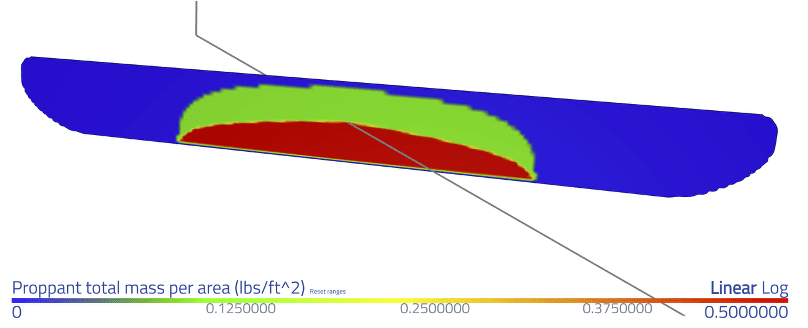
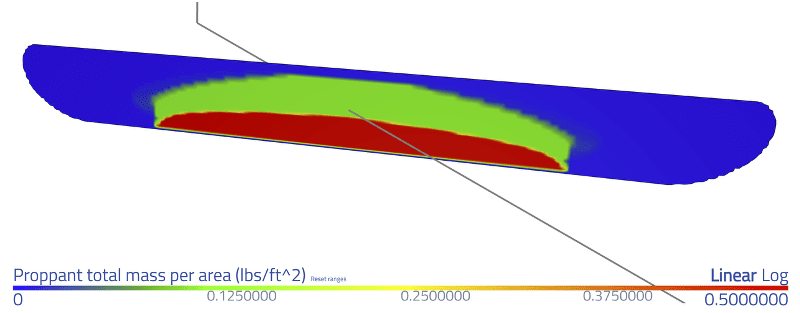
The figure below shows a rerun of the simulation with proppant immobilization activated and set to a maximum of 0.15 lbs/ft^2. The first image shows the proppant distribution at shut-in, and the second shows the final distribution of proppant after many days of shut-in.
In this case, the propped length is limited by the trapping – because proppant is held up during flow, it cannot travel as far. However, the vertical proppant placement is greatly improved by the trapping process, and proppant is now placed at the well. This representation of proppant transport is much more consistent with field data. The effects of trapping are both positive and negative – it improves vertical proppant placement but also reduces propped length.
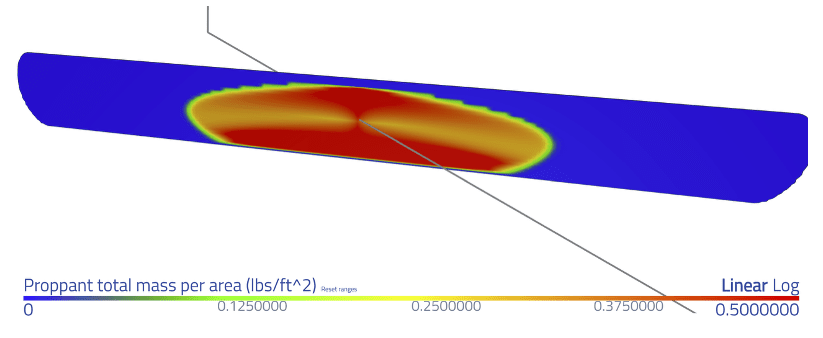
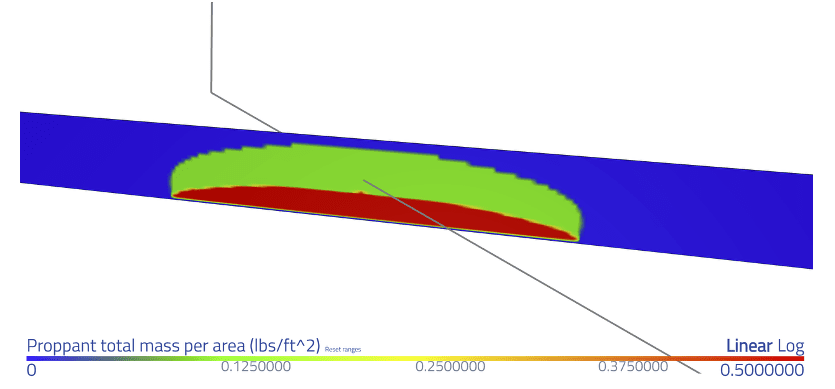
In the simulation with trapping, the proppant still settles, just like in the ‘no trapping’ case. However, above the bed, there is a ‘trapped’ proppant region, which retains enhanced conductivity. Beyond the propped area, the unpropped fracture area (shown in blue) may have some residual conductivity. However, usually the unpropped fracture conductivity is highly stress sensitive, and so consequently, quite low.
The simulation image shows a relatively uniform distribution of proppant placement in the ‘trapped’ region above the bed. However, this is an artifact of model scale. In reality, we believe the distribution of proppant is irregular. The simulation shows the average concentration, combining both the propped and unpropped patches.
Arch regions
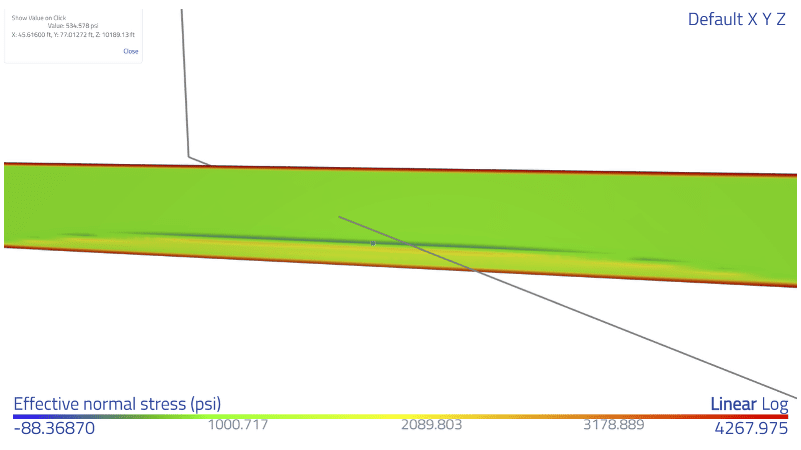
It has sometimes been hypothesized that there may be a small ‘arch’ region above the fracture ‘bed’ (Warpinski, 2009). This arch region can be simulated in ResFrac if you use a sufficiently refined mesh. For example, the image below shows the ‘effective normal stress’ along the fracture from the ‘no trapping’ simulation, zoomed-in on the bed region. We can see that there is especially high stress along the top of the bed, with especially low stress above it. This image is showing the mechanical effect creates the ‘arch’ region. In the simulation, the effective normal stress in the ‘low stress’ region is no lower than about 500 psi. Thus, it remains ‘mechanically closed.’ However, if we had a more refined mesh, we would likely see a region reaching zero effective stress and mechanical opening (this simulation is using 12 ft element height).
Even though the ‘arch’ concept is physically and mathematically reasonable, in my opinion, the proppant trapping concept points to a reason why these ‘arch’ regions may be difficult to develop in reality. Fractures are rough and the proppant placement is irregular. The proppant that settles is unlikely to form a clean ‘bed’ that would enable a continuous ‘arch’ region to develop above it. More likely, there are discontinuous and irregular ‘arch-like’ regions of reduced normal stress (rather than full fracture opening) that develop around the various proppant patches. These contribute to the overall average conductivity across the proppant pack, but do not create a discrete, continuous ‘arch’ feature across the fracture.
The New Proppant Trapping with Washout Formulation
In his new formation, Kryvenko (2025) add a proppant ‘washout’ term that reduces the amount of trapping and potentially allows remobilization:

Where:

And $u$ is the superficial velocity (volumetric rate divided by cross-sectional area), and $u_c$ is a critical superficial velocity calculated using the equations from Kryvenko (2025). The washout term is based on expressions for ‘bed load transport’ of proppant. The idea is that proppant settles down onto ledges, but if velocity is sufficient, the grains could be remobilized by turbulent suspension or saltation, the so called ‘bed load transport’ processes.
Bed load proppant transport is a topic that has gotten a great deal of attention in the proppant transport literature. In my view, its significance has traditionally been grossly overstated. As reviewed by McClure (2018), many authors express the belief that bed load transport is the dominant proppant transport process in slickwater fracturing. This claim arises from extrapolation of small-scale laboratory experiments without appropriate consideration of scaling. The concept does not hold up when applied to field-scale fracturing (Biot and Medlin, 1985; McClure, 2018). With field-scale fracture geometry and injection volume, the mechanism of viscous drag dominates, and bed load transport becomes very minor.
However, conventionally when people talk about bed load transport, they are assuming there is a single bed, placed at the bottom of the fracture. Instead, in this context, we are conceptualizing that the proppant is placed in a series of beds or patches across the entire vertical extent of the fracture. Kryvenko (2025) is proposing that a ‘bed load transport’-like process could be occurring on each of these patches, which helps sweep the proppant through and past the points of irregularity. Rather than there being only a single ‘bed’ at the bottom of the fracture, irregularities create numerous small-scale ‘beds,’ each of which can host ‘bed load transport’ processes. If there are many ‘beds’ (or, bed-like patches of irregularity) distributed across the entire vertical extent of the fracture, this is a mechanism that does scale up with the size of the fracture, unlike the classical concept of a single proppant bed placed solely at the bottom.
Thus, the Kryvenko (2025) model promises to provide the missing link between the laboratory experiments and field-scale operations. Laboratory experiments cannot be applied directly to practical problems, but at least, by considering the idea of multiple regions hosting bed-load processes distributed vertically across the fracture, we have a framework that could be used for scaling between the two.
In the Kryvenko (2025) correlation, the calculation of accounts for the grain size, grain density, fluid density, and flow velocity. Also, once immobilized, proppant cannot remobilize unless the fluid velocity is sufficiently high to exceed a critical Shields number. In the next section, we perform sensitivity analysis simulations to show the effect of changing different variables.
Sensitivity analysis simulations
In the image below, I repeated the simulation shown above, except with proppant washout turned on. The model parameters are: Kwashout = 0.0001 min^-1, Nsh,crit = 0.03, f = 0.2, ‘max aperture’ set to 0.001 ft, and the residual immobilized fraction (the fraction that can never be remobilized) equal to 0.2. With these settings, the propped half-length is 885 ft. In the original simulation without washout, the propped half-length is 650 ft.
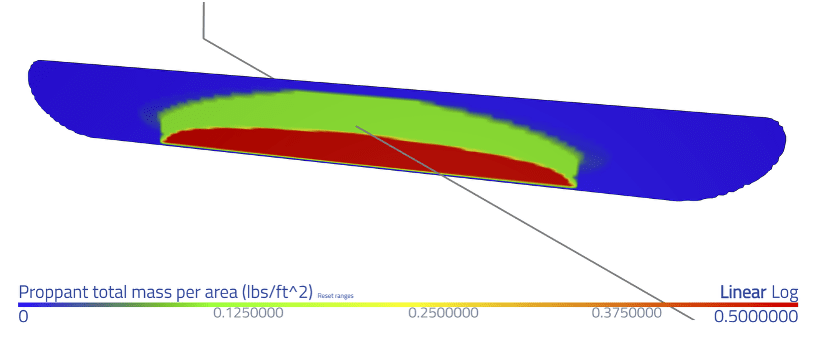
In practical application, we use field data to constrain propped length and calibrate the model using the parameter ‘maximum immobilized proppant.’ Including washout would not change this workflow. If you have a preexisting model that has already been calibrated, and you want to use washout without affecting up your current propped length, you could modify the proppant trapping parameters to recover the original propped length.
In these next two simulations, the 100 mesh proppant is replaced with 55 mesh proppant (a stand-in for 40/70). The first simulation shows the result with no washout. The second simulation shows the result with washout turned on. Unlike the case with 100 mesh proppant, there is only a slight difference in propped length between the two models. This makes sense because the larger diameter proppant should be harder to wash out, and so including the washout process has less effect. In both cases, the propped length is considerably less than with the 100 mesh, which occurs because of the greater settling velocity of the 55 mesh proppant.
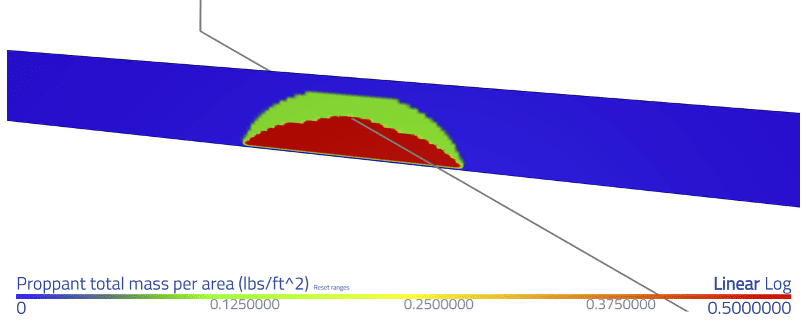
In the next two simulations, we return to the 100 mesh proppant, but now pump a 1-hour flush of proppant-free water at the end of the stage. Pumping a very large flush is not done in practice, but this is an interesting simulation case for the sensitivity analysis.
The first figure shows the ‘no washout’ case, and the second figure shows the ‘with washout’ case. In the simulation without washout, the 1-hour flush moderately increases the size of the propped area, relative to the base case without washout. However, in the simulation with washout, the 1-hour flush yields a dramatically different distribution of proppant – a significantly greater propped length, and also, a major reduction in the vertical distribution of proppant and a region of little proppant in the near-wellbore region.
Note that this simulation does not suggest overdisplacement is necessarily a major problem. Typical overdisplacement volumes from pumping down perf guns, etc., are much smaller than tested in this simulation. Actually, the phenomenon of proppant trapping is very likely why overdisplacement has not proven to be a major problem, at least in shale.
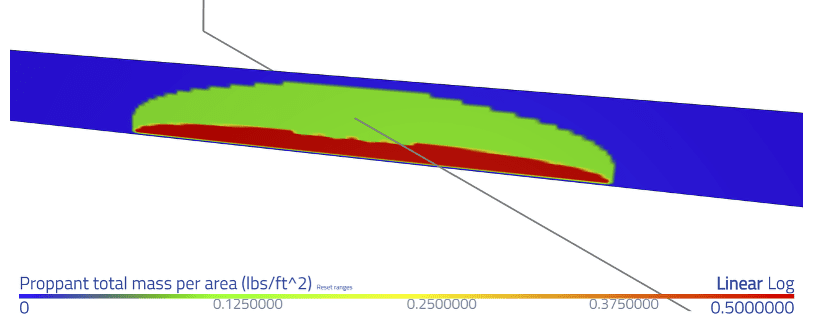
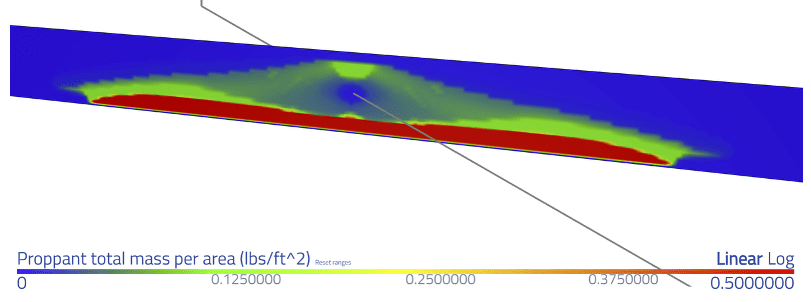
Next, we run simulations with the injection rate doubled. The injection duration is cut in half so that the volume of fluid and proppant is kept constant. In the simulation without washout (shown first), the propped region is modestly larger than in the base simulation. In the simulation with washout (shown second), the propped length is much larger. This is an intriguing result. It suggests that higher flow rate may be beneficial for propped area because it reduces trapping and helps sweep proppant further out into the formation.
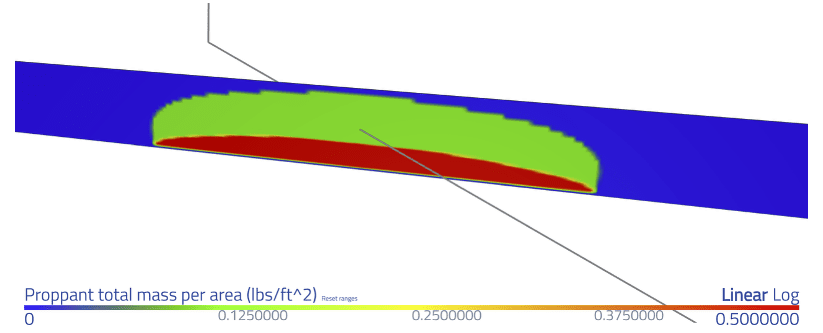
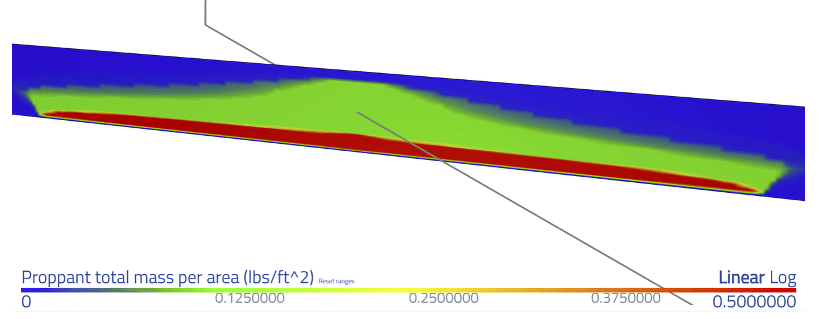
In the simulations below, the mass of proppant was kept constant, while cutting the volume of fluid in half (doubling the proppant concentration). Both simulations show modest reduction in the propped area, relative to the baseline ‘with’ and ‘without’ washout simulations. In the ‘with’ washout model (shown second), the relative impact on propped area and length is somewhat more pronounced.
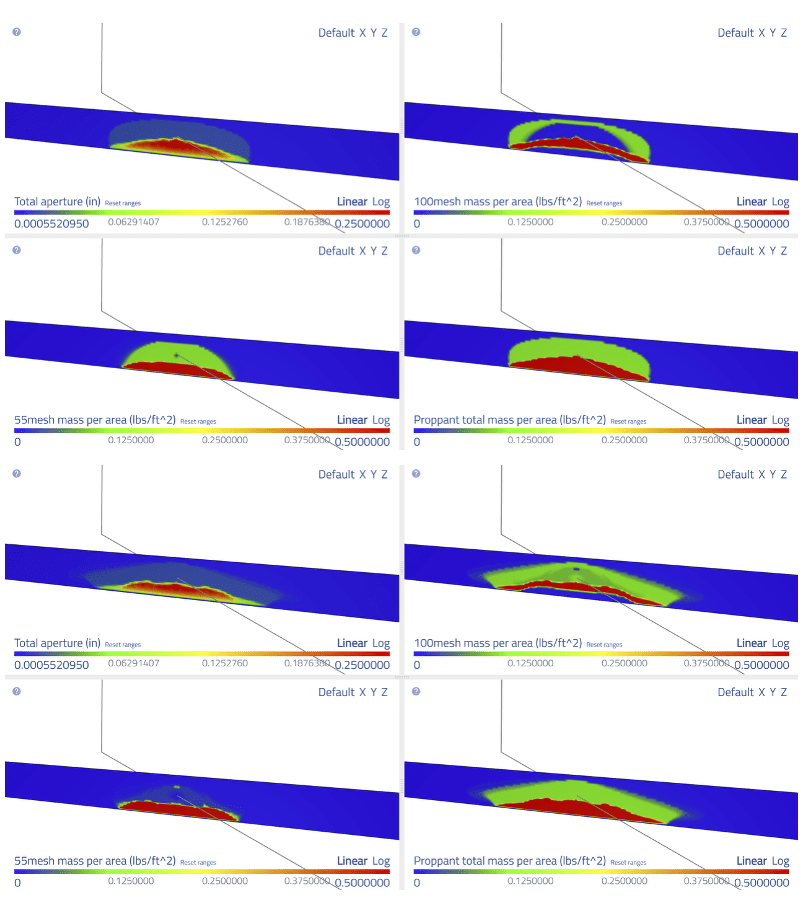
Finally, in this simulation below, the injection schedule has been modified to inject 55 mesh proppant first, followed by 100 mesh. This simulation was suggested to me by Serhii Kryvenko, who ran a similar set of sensitivities when he was testing the new washout model after it was implemented in ResFrac.
In the simulation without washout (shown first), the 55 mesh that is injected first traps around the well (lower left panel). As a result, when the 100 mesh is injected, none of it is trapped near the well (upper right panel), because the previously injected 55 mesh has saturated the capacity of the fracture to ‘trap’ proppant. Intuitively, this feels somewhat unrealistic, since we might expect more mixing and interchange between the initially injected proppant, and the subsequently injected proppant.
In the simulation with washout (shown second), the initially injected 55 mesh traps around the well, as in the ‘no washout’ simulation. However, when the 100 mesh is subsequently injected, much of the trapped 55 mesh is remobilized and replaced with the 100 mesh. The result is a more intermixed distribution of proppant across the fracture.
To summarize:
- Including washout increases the propped length. If propped length has already been calibrated without trapping, and you want to recover the calibrated model with trapping, you should adjust the base trapping parameters to recover the match.
- Directionally, the sensitivities show similar effects on propped length with or without trapping. However, trapping tends to increase the magnitude of some effects. In particular:
- Including washout dramatically changes the simulation results if performing a large flush at the end of the job.
- Including washout dramatically increases the effect of higher injection rate.
- Including washout modestly increases the magnitude of effect from changing mesh size and/or proppant concentration.
- When sequencing different types of proppant, the washout model causes more intermixing of the proppants across the fracture and allows later-injected proppant to partially replace the initially injected proppant.
How do these results mesh with field experience? Including washout in the simulation modestly increase the effect of changing concentration and mesh size. I think it’s plausible that we should be running models that somewhat increase the magnitude of these effects.
The impact of washout on injection rate is most striking – washout greatly increases the effect of injection rate. Is this reasonable? Possibly. I am reminded of a challenging dataset from Dhuldhoya et al. (2022), which we struggled to match in the paper by Singh et al. (2025). In the dataset, they varied stage length, and so implicitly, also varied flow rate per cluster. Fiber optic flow allocations suggested a large improvement in production from the greater rate per cluster. In ResFrac, we matched the trend directionally, but we found it difficult to explain the magnitude of the observed effect (Section 4.4 from Singh et al., 2025). A model with proppant washout would likely have been able to match the magnitude of the effect observed in the dataset.
Wrap-up
I am very excited about the new Kryvenko (2025) correlation. Theoretically, the correlation promises to provide the missing link between laboratory experiments – which are often dominated by ‘bed load transport’ – and the much larger fractures that we create in the field. Results from sensitivity analysis simulations using the new washout model make intuitive sense. Most intriguing, these concepts may unlock creative new frac designs. Considering the effect of washout, how might we change proppant sequencing and selection to maximize propped area and length?
Despite the promising results, we are going to be somewhat cautious rolling them out in our simulation studies. The magnitude of the effects from the washout model depend on input parameters, such as Kwashout. These need empirical calibration from field data, and this will take some time and experience.
Overall, I think this is an exciting development. It promises to improve our modeling results, and it offers engineers an exciting new direction.
References
Albrecht, Magdalene, Shannon Borchardt, and Mark McClure. 2022. Using Geochemical Production Allocation to Calibrate Hydraulic Fracture and Reservoir Simulation Models: A Permian Basin Case Study Paper presented at the SPE/AAPG/SEG Unconventional Resources Technology Conference, Houston, TX.
Bachleda, Jana, Ruben Cisneros, Dan Carson, Helm Donahue, Michael Manigold, Muqing Jin, Shuangyu Ge, Jiang Wu, and Faye Liu. 2024. Optimizing Infill Development in the Delaware Basin Through Integration of Geochemistry, Tracer, Pre-Frac Step Down Test, and Pressure Data. Paper presented at the SPE/AAPG/SEG Unconventional Resources Technology Conference, Houston, TX.
Biot, M. A., W. L. Medlin. 1985. Theory of Sand Transport in Thin Fluids. Paper presented at the SPE Annual Technical Conference and Exhibition, Las Vegas, NV.
Dhuldhoya, Karan, and Kyle Friehauf. 2022. Applications of Distributed Strain Sensing via Rayleigh Frequency Shift: Illuminating Near-Well and Far-Field Fracture Characteristics. Paper presented at the SPE/AAPG/SEG Unconventional Resources Technology Conference, Houston, TX.
Dontsov, E. V. 2023. A model for proppant dynamics in a perforated wellbore. International Journal of Multiphase Flow, 167(104552).
Gale, Julia F. W., Sara J. Elliott, Stephen E. Laubach. 2018. Hydraulic fractures in core from stimulated reservoirs: Core fracture description of the HFTS slant core, Midland Basin, West Texas. Paper URTeC: 2902624.
Kryvenko, Serhii. 2025. Proppant Trapping and Washout in Rough Hydraulic Fractures. Available at Research Square.
McClure, Mark W. 2018. Bed load transport during slickwater hydraulic fracturing: insights from comparisons between published laboratory data and correlations for sediment and pipeline slurry transports. Journal of Petroleum Science and Engineering 161: 599-610.
McClure, Mark. Matteo Picone, Garrett Fowler, Dave Ratcliff, Charles Kang, Soma Medam, and Joe Frantz. 2020. Nuances and frequently asked questions in field-scale hydraulic fracture modeling. SPE-199726-MS. Paper presented at the SPE Hydraulic Fracturing Technology Conference and Exhibition, The Woodlands, TX.
McClure, Mark W. 2025. Preliminary Analysis of Results from the Utah FORGE Project. Paper presented at the 50th Workshop on Geothermal Reservoir Engineering, Stanford University.
McClure, Mark, Charles Kang, Chris Hewson, Soma Medam, Egor Dontsov, Ankush Singh, Carlo Peruzzo, and Elizaveta Gordeliy. 2025. ResFrac Technical Writeup. 19th Edition. arXiv:1804.02092.
Ponners, Chris, Mohsen Babazadeh, Craig Cipolla, Karan Dhuldhoya, Qin Lu, Ripudaman Manchanda, Daniel Ramirez Tamayo, Steve Smith, Mojtaba Shahri, and Mark McClure. 2024. Interference Testing in Shale: A Generalized ‘Degree of Production Interference’ (DPI) and Developing New Insights into the Chow Pressure Group (CPG). Paper presented at the SPE/AAPG/SEG Unconventional Resources Technology Conference, Houston, TX.
Ponners, Chris, Mohsen Babazadeh, Craig Cipolla, David Cramer, Egor Dontsov, John Lassek, Ripudaman Manchanda, Michael McKimmy, Danial Ramirez Tamayo, Mojtaba Shahri, and Mark McClure. 2025. Case Studies Applying a Wellbore-Proppant Simulator in the Midland Basin, Montney, and Bakken Shale Plays. Geomechanics and Geophysics for Geo-energy and Geo-resources, 11(110).
Singh, Ankush, Mohsen Babazadeh, Craig Cipolla, Karan Dhuldhoya, Arjang Gandomkar, John Lassek, Ripu Manchanda, Michael McKimmy, Daniel Ramirez-Tamayo, Reza Safari, Mojtaba Shahri, Steve Smith, and Mark McClure. 2025. Far-field Drainage Along Hydraulic Fractures: Insights From Integrated Modeling Studies in the Bakken and Permian Basin. Paper presented at the SPE Hydraulic Fracturing Technology Conference and Exhibition, The Woodlands, TX.
Warpinksi, N. R. 2009. Stress Amplification and Arch Dimensions in Proppant Beds Deposited by Waterfracs. Paper presented at the SPE Hydraulic Fracturing Technology Conference and Exhibition, The Woodlands, TX.