
The 2026 HFTC included 50+ technical paper presentations, a special session highlighting papers from the American Rock Mechanics Association (ARMA), and a dynamic opening session featuring the Secretary of Energy, Chris Wright, and a diverse panel discussion with representatives from Chevron, Exxon, US Department of Energy, and Colorado School of Mines.
This is my first ResFrac blog post and my first blog post ever. Mark usually writes this blog, but this year I volunteered to provide my selection of interesting papers from HFTC. I am not attempting to select the best papers, just papers that I found interesting. Most of this blog focuses on papers that fall into two themes connected to much of the work we do at ResFrac. The theme papers are summarized, but I provide additional details on each paper at the end of this blog for those who want more information. Before jumping into the two themes, here is a very lightning-round summary of few other interesting papers.
Simulation-Driven Optimization of Simultaneous Frac Execution Strategies: Trade-Off Analysis of 2- And 3-Well Simul-Frac, Cost Models, Operational Efficiency, Flow Rates, and Stage Lengths
Edison et al. (2026, SPE 230625)
This paper provides an interesting discussion of the operational tradeoffs been 2 and 3-well simul-fracs, suggesting that more is not always better. However, we still need to better understand the relationship between frac order, sequencing, and pad-level production and EUR.
Comprehensive Analysis of Proppant Logging: A Case Study from the Hydraulic Fracturing Test Site in Qingcheng Shale Oil
Xinbin et al. (2026, SPE 230651)
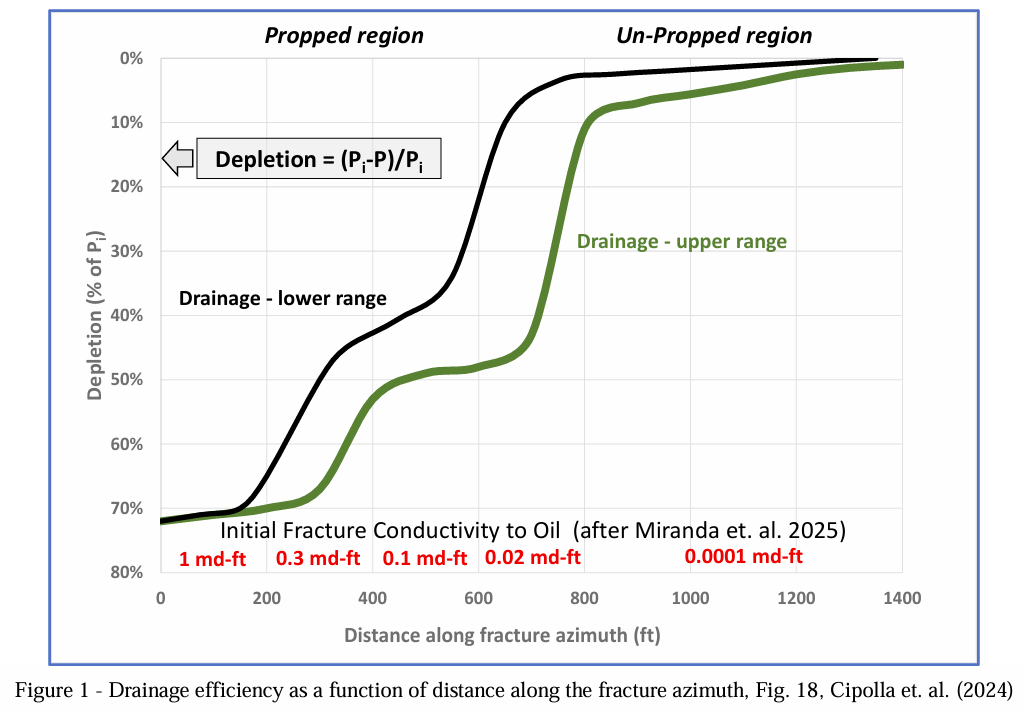
This paper summarizes insights from the Qingcheng Hydraulic Fracture Test Site (HFTS). The paper presents numerous diagnostic measurements, core-through observations, and cuttings-based proppant identification. The paper provides important estimations of proppant location and distribution, indicating propped lengths of ~540 ft and propped heights of ~160 ft. The propped lengths are remarkably similar to the drainage extent presented in Fig 1 below by Cipolla et al. (2025, URTeC 4244384). These data may suggest practical limitations for proppant transport using low viscosity fluids, providing valuable measurements to calibrated proppant transport models, characterize fracture conductivity, and predict drainage.
In-Field Application Results of Polymer Coated Proppant Demonstrates Increased Value in Unconventional Well Completions
Huckabee et al. (2026, SPE 230622)
This paper documents several field trials where friction reducer (FR) is added to the proppant stages by coating the proppant with the FR polymer, as opposed to adding the FR to the frac water. The authors show examples where substituting FR-coated proppant reduced treatment pressures while using similar or less FR, resulting in significant cost savings. The cost savings are attractive, but I was most interested in the examples showing a 23% to 38% increase in production in wells with FR-coated proppant. It is always difficult to evaluate production differences using a small number of wells, but these improvements got my attention. Is proppant transport improved by coating the proppant with polymer? After discussing the paper and product in more detail with Paul Huckabee, I got the impression that this could be a cost-neutral or cost-saving application. Paul did not see any potential for production losses since the same FR is used for the coating. However, he acknowledged that there is more operational complexity due to the on-site coating.
Drainage Fracture Height Characterization Using Rayleigh Frequency Shift Distributed Strain Sensing (RFS-DSS) in a Vertical Monitoring Well from HFTS-2
Wang et al. (2026, SPE 230609)
This paper presents detailed ResFrac modeling of RFS-DSS measurement for HFTS-2 to estimate drainage height, integrating multiple diagnostics to improve interpretation. This paper is packed full of interesting technical details, and I would recommend a detailed read for those interested in modeling fiber-based strain measurements to estimate drainage. The authors conclude that about 40% of the created fracture height is being drained. As we continue to gather more drainage measurements, trends may become clear. Looking at recent measurements, we are draining 40-60% of the fracture area. One important observation, the authors report a “modest” correlation between fiber-based drainage and pressure measurements using a “highly” calibrated model to interpret the strain measurements. This highlights the need for direct pressure measurements to reliably measure drainage efficiency, at least until the interpretation of fiber-based pressure measurement becomes more accurate.
Now let us move on to the two themes: (1) Perforation effectiveness, stage uniformity, and well performance and (2) Real-time Frac Optimization.
Theme 1: Perforation effectiveness, stage uniformity, and well performance
The first theme explores the link between perforation effectiveness, stage uniformity, and well performance. The goal of limited entry perforating strategies is to uniformly distribute fluid and proppant to each cluster, while optimizing the number of clusters per stage given operational and technical limitations. There are three papers on this theme I would like to highlight. SPE 230643 by Cramer et al. (2026) highlights best practices for perforating strategies to achieve uniform fluid and proppant distribution in all clusters. SPE 230623 by Bourgeois et al. (2026) analyzes perforation performance using a large perforation imaging database, showing the variability between the designed perforation strategy and actual perforations, while also documenting the frequency of plug failures. SPE 230663 by Fatheree et al. (2026) presents a dataset of 200 wells in the Bakken with acoustic measurements of fluid uniformity, specifically the Uniformity Index (UI), and the associated production trends. This is the first paper to show a relationship between UI and production, concluding that a 0.1 increase in UI results in a 7% increase in production. As we might expect with production comparisons in unconventional resources, there are significant variations in the data, and it may be difficult to reliably quantify the magnitude of the production increase. However, there is more to this story.
The value of uniform fluid distribution was examined in URTeC: 4044071, “The Perfect Frac Stage, What’s The Value?” (Cipolla et al., 2024). This work utilized a highly calibrated ResFrac model to develop a relationship between UI and production in the Bakken, suggesting that an increase in UI of 0.1 would increase first year production by 2.5%, increasing NPV by $300,000 per well. This work may provide a low-end for production increase and value, with the work of Fatheree et al. (2026) suggesting there is even greater value in striving for the perfect frac stage. Now the final chapter of this story.
For those who attended Dave Cramer’s presentation of SPE 230643, there was a slide in the presentation that was not in the paper. I reviewed the slide with Dave to make sure I got all the details right. The slide showed that oriented perforating resulted in a 13% increase in production compared to non-oriented perforating. Dave indicated that all other completion and limited entry parameters were the same for both datasets. Although we do not have measurements of UI, this data also suggests that there is a material production increase when fluid and proppant distribution is more uniform.
Theme 2: Real-time Frac Optimization
The second theme focuses on real-time frac optimization. You might wonder, what is the connection between real-time frac optimization and ResFrac. One connection was already highlighted in the “Perfect Frac Stage” paper, Cipolla et al. (2024, URTeC: 4044071) introduce the vision of Autonomous and Intelligent Fracturing (AIF), but it was the ResFrac modeling that was used to predict the potential value of AIF. Without a clear value proposition, it is difficult to justify costly innovations like real-time optimization. The industry’s journey to real-time frac optimization continues and is highlighted in three HFTC 2026 papers.
The paper by Navaiz et al. (2026, SPE 230613) highlight the first “closed-loop fracturing” program using measurements from offset well disposable fiber as input to a volume reallocation decision logic. The paper by Fatheree et al. (2026, SPE 230647) presents real-time frac optimization using treatment well measurements. Acoustic friction analysis is used to calculate perforation efficiency and uniformity index to evaluate the effectiveness of each stage in real-time. The authors present examples of real-time optimizations, including adjustments to the proppant schedule and treatment rate, while also discussing identification of plug leaks. The final paper is this theme, Agarwal et al. (2026, SPE 230658), presents a deep learning (DL) model that predicts surface treatment pressures. I highlight this paper because treatment pressures are an “always available” free diagnostic that has yet to be fully unlocked. Although early in its development, the author’s DL model forecasts treatment pressure 5 minutes in the future, with the goal of providing forecasts to diagnose and mitigate treatment problems. The goal of this model is to predict screen-outs and support real-time stage-level completion optimizations. The authors did not specifically discuss the application of this model to evaluate completion effectiveness, but that would be an anticipated evolution and provide a continuous measurement for real-time frac optimization. However, even with significant improvements, will these models be sufficiently accurate to reliably enable real-time optimization?
The real-time optimization papers illustrate recent advancements in automation and control systems, forecasting, and measurement technologies. The next step in our journey to fully autonomous real-time fracture treatment optimization is advancing the value proposition. This is where ResFrac modeling will be critical. We need to better understand the economic and production impacts of various optimization algorithms. For example, how do we properly apply VRF measurements and what is the production impact of the volume reallocation logic presented by Navaiz et al. (2026, SPE 230613)? And how do we optimize this category of real-time logic? Similar questions arise when applying real-time changes using perf efficiency or UI measurements as described by Fatheree et al. (2026, SPE 230647). Although we would like to use production data to “measure” the value of real-time frac optimization, the variability in well/pad performance combined with small (~5%) but valuable production increases, dictates that we start with modeling to advance real-time optimization.
The “theme” papers illustrate the integration of measurements and models to create value (the 3Ms, “Measurements to Models to Money”). Measurements are required to develop and calibrate models, while models are needed to accelerate learnings and innovate, but it is the actions and “best practices” that come from the measurements and models that create value. As these datasets and publications grow, the link between completion effectiveness, real-time frac optimization, modeling, and production will become even more clear. For those who want additional information, I have provided a more detailed review of the theme papers below.
Completion Best Practices: Unconventional Reservoir (UCR) Fracturing Perforation Strategy and Emerging Insights
Cramer et al. (2026, SPE 230643)
This paper provides a good summary of limited entry perforation design, both theory and practice, and true to its title is full of recommendations for best practices. The paper emphasizes that perforation design is the primary factor that controls completion effectiveness, with optimum designs ensuring that fluid and proppant are evenly distributed to all clusters while maximizing the number of clusters per stage.
The authors discuss issues such as perforation hole size and gun orientation, and choosing the correct discharge coefficient, illustrating that hole sizes vary with gun orientation and recommending a Cd~0.95. The authors explore the impacts of near wellbore tortuosity on breakdown and completion effectiveness. The paper references the observations from the US Department of Energy Nevada Test Site mine-back project (reference Fig 2, Warpinski 1983), showing that fractures initiate for the base of perforations with complex geometries due to interactions with the near-wellbore stress cage, supporting the concept that the perforation entry hole is the primary “controllable” factor affecting fracture initiation and propagation. Due to this complex initiation, the authors recommend a minimum spacing of 25 ft for perforation clusters to avoid communication between clusters. The issue of stage isolation and plug failures was highlighted along with the application pump-down diagnostics to evaluate stage isolation.
The authors also discuss the sweet spot for limited entry pressure drop, recommending 800-1000 psi as the ideal limited entry pressure drop throughout the treatment (reference Fig 9). Properly designing for the effect of perforation erosion is key to maintaining the optimum pressure drop, fluid distribution, and proppant distribution. Recent work has provided significant insights into the complex relationship between perforation strategies and treatment designs and perforation erosion, fluid distribution, and proppant distribution. Simply designing a perforating strategy to achieve good fluid distribution is not sufficient, we need to ensure fluid and proppant are uniformly distributed to all clusters.
Recognizing these issues, ResFrac developed the StageOpt App to provide fast evaluation of perforating strategies to improve proppant and fluid uniformity, while incorporating these wellbore proppant transport and perf erosion mechanisms into ResFracPro. The trade-off between number of clusters (i.e. – fractures) per stage and fluid uniformity is a delicate balance that affects completion costs and well performance. One of the interesting findings has been that there is not a “one size fits all” best overall perforation design. Phenomena such as the magnitude of perforation erosion vary significantly between datasets, and these differences mean that optimization requires context-specific data collection and optimization.
Frac Optimization: Analyzing Operational Metrics That Matter
Bourgeois et al. (2026, SPE 230623)
While Cramer et al. (2026) provides best practices for perforating strategies, Bourgeois et al. (2026) presents a summary of operational performance using observations from a large database of perforation imaging. The authors use six metrics to assess performance: 1. Cluster depth control 2. Plug depth control 3. Perforations shot on connections 4. Phase orientation accuracy 5. Plug performance 6. Shot size variability. Keeping with our theme of perforation effectiveness and stage uniformity, let us focus on the key perforating metrics that affect fluid and proppant uniformity: phase orientation accuracy, shot size variability, and shot on connection.
So how are we doing compared to our designs? Perforating on connections (collars) can lead to perforation hole sizes outside the target size range and reduce treatment uniformity. On average, about 10 collars are perforated per 10,000 ft of lateral. As emphasized by Cramer et al, (2026), perforation orientation affects hole size. This paper reports that perforations are shot on average +/-25 degrees off their intended orientation with a standard deviation of 30-degress. The authors report that on average perforations are 7% off from the spec size, with a standard deviation of 9%. Although this appears like a small variation, this can result in more than 30% difference in perforation volume. These non-ideal outcomes result is higher variability in perforation hole sizes that reduce fluid and proppant uniformity. Stage uniformity is further reduced due to plug problems, with 60% of wells experiencing at least one plug related issue, damage, or full failure. The authors emphasize that many operators, guided by measurements, are continually improving their perforating strategies and achieving more uniform fluid and proppant distribution.
The Effect of Cluster Uniformity Index on Production: A Look at 200 Wells in the Williston Basin
Fatheree et al. (2026, SPE 230663)
This is the first paper to evaluate the correlation between stage-level fluid distribution and production. The author’s introduce acoustic friction analysis, a technology that uses small rate changes to generate an acoustic signal that can be used to extract pipe and perforation friction. The perforation friction is measured at the beginning of the treatment (pad) to provide a baseline, using subsequent measurements to evaluate perforation efficiency and fluid uniformity index (UI) as the job progress. UI measurements were gathered on 200 Bakken and Three Forks wells and compared to 9-month production data. The UI used for comparison is the final, end of job, value. As you might expect, there is significant variability in production due to geology, production constraints, etc. that makes simple correlations challenging. Most of the data is from Bakken Wells and the authors present correlations using all Bakken wells and area-specific correlations. Figure 12 in the paper shows the area specific correlations. While the sample size is smaller when using area-specific groups and the variability is still significant in many areas, the authors conclude that there are statistically significant positive trends. The authors report an average of 7% increase in production with every 0.1 increase in UI. As I noted in the summary, this is significantly higher than the 2.5% we predicted in our “Perfect Frac Stage” ResFrac modeling study, but the most important takeaway is the positive and material impact of improved fluid uniformity on production.
Transforming Hydraulic Fracturing: The First-Ever Closed-Loop Completions Program
Navaiz et al. (2026, SPE 230613)
In the paper the authors present a large database of offset well fiber measurements (primarily volume to first response or VFR) that was used to characterize the variation in fracture growth rates, identifying VFR responses that signal good, average, and bad stages. The author’s decision logic reallocated treatment volumes from bad stages to good stages, keeping the total treatment volume constant. The bad or low VFR stages were assumed to have less uniform cluster fluid distribution and reducing the treatment volume would mitigate some of the fracture overlap or over stimulation, while increasing treatment volume in good or high VFR stages would exploit the better-than-average cluster fluid distribution and improve stage-level stimulation.
The distribution of frac growth shown in Fig 4 illustrates where fracture growth rate measurements trigger fluid addition (Add) or reductions (Cut). The decision logic would add fluid to the slowest 25% of the stages, while decreasing fluid from the fastest 25% of the stages. These measurements highlight the variability in stage VFR behavior, which could suggest variability in stage-level completion effectiveness. However, the relationship between stage-level fluid uniformity and VRF is not well understood and may be complicated by asymmetrical fracture growth, stress shadowing, stage and well completion sequencing, and the location of observation wells. In many cases, there is only one observation well, potentially introducing spatial bias to the measurement.
The limitation of this real-time application is the need for an offset “observation” well to deploy the disposable fiber. Although not discussed in the paper, it is likely that pressure measurements or Sealed Wellbore Pressure Monitoring (SWPM) would provide a lower cost measurement for this application. During the Q&A, it was noted that this real-time application may not be scalable, as offset observations wells are not routinely available and never available for all wells on a pad. In addition, there is still a lot of work required to optimize real-time treatment changes based on VRF measurements. This paper introduces measurements and decision logic for real-time optimization and demonstrates that automation and control systems can “autonomously” execute the design changes.
Employing Live Subsurface Measurements to Support Supervised and Autonomous Intelligent Decision-Making While Fracturing
Fatheree et al. (2026, SPE 230647)
The paper utilizes the same acoustic friction analysis presented in SPE 230663, but this paper focuses on real-time applications. Perf efficiency and UI are measured throughout the treatment, providing real-time measurements to evaluate completion effectiveness of each stage. The authors show examples where plug failures are identified, suggesting that a stage may be less effective and treatment volume should be adjusted. However, the focus of the real-time optimization is perf efficiency and UI, with three primary adjustments: (1) Pump rate, (2) FR loading, and (3) proppant ramp. The authors present examples where adjusting these parameters results in improved end-of-job fluid uniformity. Like the previous paper (Navaiz, 2026), this paper also discusses the application of volume reallocations using real-time measurements. The authors show that UI is variable (Fig 6 in the paper) and suggest that volume can be reduced for the lower performing stage and reallocated to higher performing stages.
The primary difference between the work of Fatheree et al. (2026) and Navaiz et al. (2026) is the measurement technology and architecture. The treatment well measurements presented by Fatheree et al. (2026) enable real-time optimization of all stages, while the offset well measurements presented by Navaiz et al. (2026) are limited to a subset of stages and may not be scalable. It is likely that combining offset well measurements on a subset of stages with treatment well measurements on all stages could further enhance the optimization decision logic.
While the two papers present advancements in real-time operations, measurements, and optimization, there is still a lot of work to be done before treatments are fully autonomous – including the optimization. Although volume reallocation appears promising, the impact of changes in stage-level treatment volumes on production is yet to be determined. In addition, while changes in proppant schedule, rate, and FR concentration may mitigate degrading UI, they could increase treatment volume and cost and change fracture geometry and conductivity profile. This is an area where high-fidelity ResFrac modeling can provide significant insights to improve decision-logic and develop ML/AI/proxy models for rigorous real-time “economic” optimizations.
Using Deep Learning to Forecast Fracture Treating Pressures in Real Time
Agarwal et al. (2026, SPE 230658)
This paper provides a good overview of the complexity of forecasting time-series data and the application of Deep Learning models. The authors discuss the evolution from physics-based linear regression models to a deep learning model, illustrating that the deep learning model provides better forecasts. This model was trained on data from 1500 stages, but the authors note that additional stages are needed to improve the accuracy of the model. Deep learning models, like most analytics, require large datasets to develop reliable models. This can many times limit the application of these models, as many operators have much smaller datasets specific to their area of operations. This model was developed by a large service company with access to a huge database of treatment pressures and completion data.
The paper provides lots of detail for the data scientists, but my interest focused on the under-exploited application of treatment pressure evaluation. These models can be trained using a diverse range of data, including logs, completion details, and geologic properties. The focus of this work was developing a model that could forecast treatment pressures and “predict” screen-outs and evaluate stage-level completion effectiveness. If the application can be extended to reliably predict stage-level completion effectiveness, it may become an extremely low-cost (almost free?) measurement to inform real-time frac optimization. The next step in the application of “time series” frac treatment pressures is the incorporation of production data, connecting treatment behavior to well performance.