
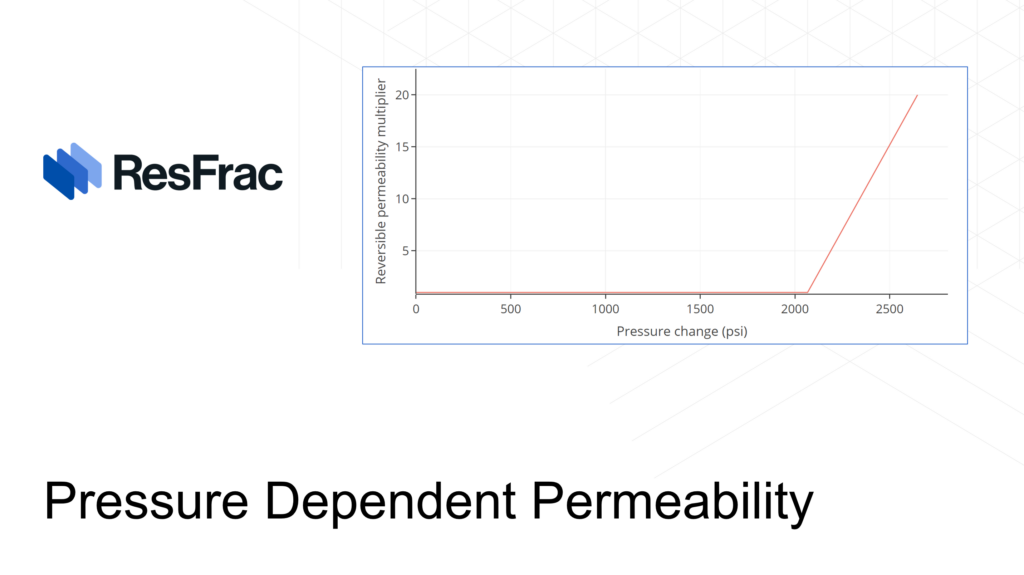
Pressure dependent permeability (PDP) tables allow matrix permeability to vary as a function of pressure change. This document explains how reversible and irreversible PDP tables are configured in ResFrac and the primary use cases.
The multiplier is applied to the base permeability defined in the facies list in addition to the global permeability multiplier and curve-set specific multipliers.
Two table types are available. The reversible PDP table determines the multiplier from current fluid pressure relative to initial conditions, allowing permeability to increase or decrease dynamically. The irreversible PDP table uses the maximum/minimum fluid pressure each matrix element has experienced, capturing permanent permeability changes from fracturing or compaction.
The most common application of PDP in ResFrac is to capture accelerated leakoff during hydraulic fracturing. Without substantial PDP, early-time water flowback is often overestimated because fractures remain partially open and fluid flows back before closure. PDP mimics the opening of secondary fractures around the primary fracture, increasing effective leakoff surface area. A typical setup increases the multiplier linearly as net pressure approaches (Shmin – Pinit).
PDP can also model stress-sensitive permeability in shale plays where matrix permeability declines under depletion, or in unconsolidated sands with strong pressure sensitivity.