
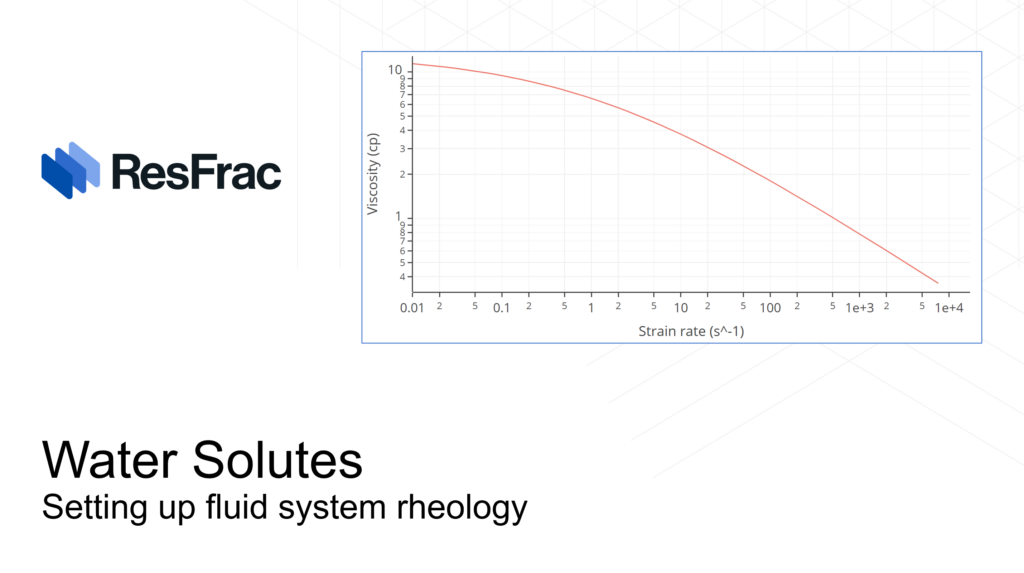
ResFrac models fluid additives using water solutes; the simulator tracks the mass balance of dissolved components in the water phase throughout the simulation domain at every timestep.
Three solute types are available. Inert solutes act as tracers with minimal impact on fluid properties, though they do slightly adjust water density and viscosity through their effect on dissolved solids. The ’modified power law’ type imparts non-Newtonian viscosity to the water phase, making viscosity dependent on flow rate. ’Modified power law cross-linked gel’ behaves similarly but excludes the additive’s contribution to wellbore friction, approximating the behavior of a gel that cross-links upon entering the formation.
It is not necessary to include every fluid additive explicitly. Adding more solutes increases simulation run time, so a parsimonious approach is recommended. In most cases, one or two solutes are sufficient: at minimum, one representing your primary viscosity-adding additive (friction reducer, HVFR, guar, etc.), and optionally one representing a degraded form if the additive breaks over time.