
Shale wells can experience significant production losses after a frac hit, yet the severity varies considerably by formation. This document examines the damage mechanisms that contribute to these losses and explains how ResFrac models them.
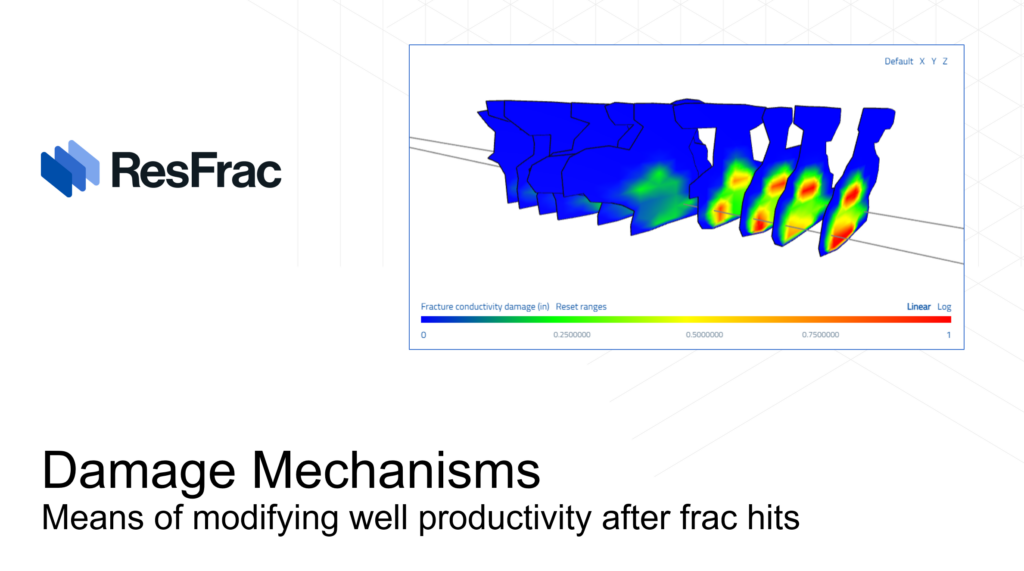
ResFrac tracks four distinct types of post-frac-hit damage, which can be simulated individually or in combination: fracture conductivity damage, fracture relative permeability damage, fracture skin damage, and water block damage.
Fracture conductivity damage refers to physical blockage within the fracture itself. Field evidence from formations like the Woodford and Montney shows recovery of solid particles composed of asphaltenes, crushed proppant, formation fines, and iron oxide. Iron in the formation reacts with dissolved oxygen in frac fluid to form iron oxide, which creates nucleation points for asphaltene agglomeration and cements solids together. This mechanism is formation-specific, which explains why frac hit damage is severe in some plays but minimal in others such as the Bakken.
Water block and fracture skin damage involve reduced flow near the fracture walls. Capillary end-member effects can cause injected water to accumulate along fracture walls rather than flowing deeper into the formation. This effect is more pronounced after a frac hit on a depleted parent well than during the original fracturing job, because lower formation pressure provides less driving force to overcome capillary resistance.
The document describes how each damage mechanism is configured in ResFrac, including the parameters that control severity and reversibility, and how preload treatments and chemical remediation can be modeled to evaluate mitigation strategies.